
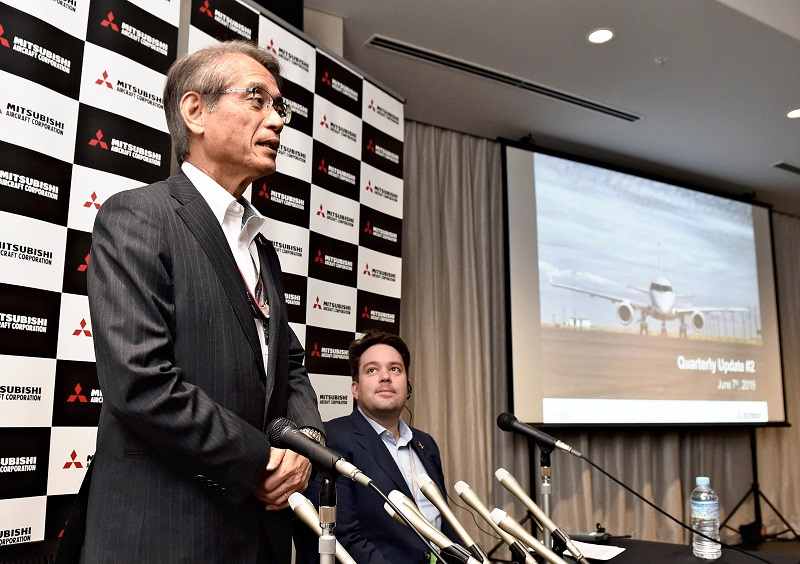
Hisakazu Mizutani, then president of Mitsubishi Aircraft Corp., left, speaks at a press conference in June 2019 with Alex Bellamy, then chief development officer, at his side. Bellamy joined the company from Canadian aircraft maker Bombardier Inc.
15:27 JST, April 1, 2021
In January, silence fell at a plant in Tobishima, Aichi Prefecture, which was supposed to assemble the country’s first homegrown passenger jet, the Mitsubishi SpaceJet (MSJ).
About three months before, in October last year, Mitsubishi Heavy Industries (MHI) announced that it would freeze its plan to mass-produce the aircraft. It had taken too much time to obtain the “type certificate” required to fly the passenger aircraft, and the drastic decline in travel demand due to the coronavirus pandemic dealt the undertaking another blow.
Aichi Prefecture, where the MHI Tobishima plant is located, is known as a center for the aviation industry. Quite a few parts makers have made large capital investments in anticipation of mass production of the aircraft.
At a meeting held by the Economy, Trade and Industry Ministry in January, Aichi Gov. Hideaki Omura, 61, asked for the project to be quickly resumed after the pandemic is over.
However, a senior official at a related company said, “Since our sales declined, some of our employees were taken in by a group company of Toyota Motor Corp. Even if the project is resumed several years from now, it will not be easy to gather staff again.”
Delayed 6 times
MHI Nagoya Aerospace Systems Works has played a major role in developing the MSJ aircraft. It was involved in the development of the Zero fighter, Mitsubishi F-1 supersonic fighter and the homegrown propeller passenger plane YS-11.
Takashi Nishioka, 84, and Hideaki Omiya, 74, who were senior officials there, later became presidents of MHI.
When the development project started for the Mitsubishi SpaceJet in 2008, MHI expected to be able to deliver the aircraft in five years.
MHI was confident, as it was producing aircraft engines as well as fighters. It also supplies many parts to U.S. aircraft maker Boeing, including plane wings of the Boeing 787 aircraft. According to a former senior economy ministry official, the government also thought it would not be difficult for MHI to enter the passenger jet market if all its technologies were brought together.
However, the reality was not so simple.
MHI stuck to the idea of developing the passenger aircraft on its own, and it had trouble procuring and managing about 1 million parts. One example was seats — the company put so much emphasis on making them lightweight that comfort was given short shrift, leading to bad reviews. The delivery of the aircraft was delayed six times due to design changes and other reasons.
As a revival measure, MHI hired many foreign staff. Mitsubishi Aircraft Corp., MHI’s development subsidiary, had 400 foreign employees at one time. The company switched its official corporate language to English, which resulted in poor communication with Japanese engineers.
MHI President and Chief Executive Officer Seiji Izumisawa, 63, who made the decision to freeze the mass-production plan, said: “The full recovery of market conditions for aviation-related businesses will take place in 2024 or later. To enhance profitability, we will minimize the cost of developing the MSJ aircraft.”
Development costs have totaled nearly ¥1 trillion, which has put a financial burden on the company. Soon after the suspension of the mass-production plan was announced, MHI stock price turned around. Over the two months through the end of last year, the company’s stock price rose about 40%.
Learning from the experience, MHI began making efforts to broaden its perspective.
In October 2020, the Yokohama Hardtech Hub opened on the premises of an MHI plant in Naka Ward, Yokohama. This facility was created in response to Izumisawa’s instructions to come up with a new approach.
In a part of the Keihin industrial zone, there was a 20,000-square-meter plant with ceilings over 10 meters high. It was once used to produce gas turbine parts. This large plant has since been refurbished into a facility that houses startups.
It has equipment that many startups with insufficient financial resources would struggle to obtain, such as large-sized cranes and high-voltage power supplies. Dangerous items can be brought into the facility, and thermal vacuum tests and vibration tests can also be conducted there.
“The floor is flat, which makes it easy to operate high-precision robots,” said Takashi Nakamura, 45, the president of machinery maker Nichietsu Machinery Co., which is located in the facility.
MHI aims to use the facility as a base to deepen communications with external startups and educational institutions.
Takashi Takagi, 45, who is responsible for the Yokohama Hardtech Hub, said, “Startups can quickly complete processes from planning to commercialization, so we will learn from them and bring a new vitality to the company.”
At present, only seven startups are operating in the facility. MHI plans to increase the number to 50.
MHI Chief Strategy Officer Hitoshi Kaguchi, 61, who assists Izumisawa, said: “It’s wrong to think that we have technological superiority. We have to try to know what is in the areas we don’t know. That attitude is becoming more and more important.”
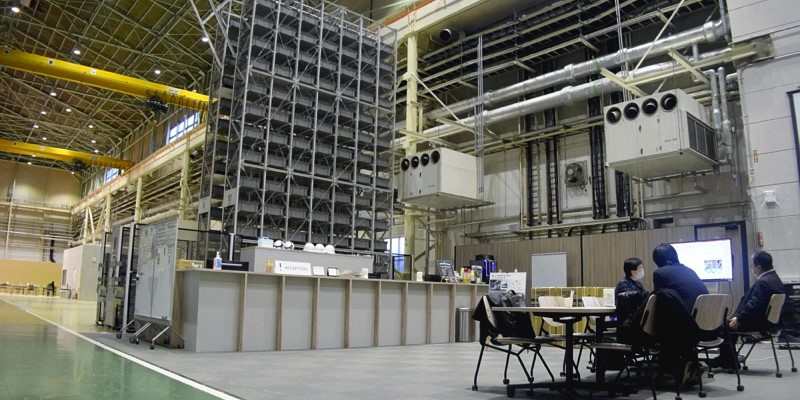
Employees work at a large factory, the Yokohama Hardtech Hub, opened by Mitsubishi Heavy Industries.



Most Read
Most read in the last 24 hours
-

Govt May Revise Law to Allow Export of Defense Equipment for Free
-
Undrafted Japanese Kicker Signs with Raiders; ‘My Appeal Is My Ac...
-
Number of Immigration Officer-Escorted Forced Deportations in Jap...
-
Spring Bear Hunting Gets Fully Underway As Prefectures Deal With ...
-
Princess Aiko Enjoys Imperial Court Music, Dance; Production, Cos...
-
Shifts Startup Focus to Nurturing Global Winners
-

Mother Supports My Sister Too Much, Gives Her Kids Much More Than...
-
Dior's New Concept Store in Tokyo's Trendy Daikanyama Area Incorp...
Most read in the last 7 days
-
Earthquake Hits Japan's Tohoku Region; 3-meter Tsunami Warning Is...
-
China, South Korea Object to Japanese PM Takaichi's Ritual Offeri...
-

Trump Extends the Ceasefire with Iran but Keeps the Blockade
-

India's Arms Indigenization Quest for Self-Reliance / New Delhi S...
-
¥1,000 Coins to Be Issued to Mark Anniversary of Beginning of Jap...
-

Most Serious Cyberattacks against the UK Now from Russia, Iran an...
-

Trump Opposes United–American Merger, Signals Support for Spirit
-
System Malfunction in Haneda Airport Causes 83 Flight Cancelation...
Most read in the last 30 days
-
Earthquake Hits Japan's Tohoku Region; 3-meter Tsunami Warning Is...
-
Police Find Child's Shoe During Search for Missing Boy in Nantan,...
-
Body Found in Nantan, Kyoto Prefecture, During Search for 11-Year...
-
China, South Korea Object to Japanese PM Takaichi's Ritual Offeri...
-
Cherry Blossoms, Rapeseed Flowers Perform Colorful ‘Duet’ in Niig...
-
Trump Extends the Ceasefire with Iran but Keeps the Blockade
-

Olympic Gold Medal-Winning Figure Skaters Riku-Ryu Announce Retir...
-
Japanese Prime Minister Takaichi Speaks to Pakistani Prime Minist...
Top Articles in Business
-
Foreign Tourists Set New Record in March; 30% Drop in Visitors from Middle East
-

Japan’s ANA to Introduce Fuel Surcharges to Domestic Flights from Fy27, Driven by Rising Fuel Costs, Declining Profits
-
Toyota Motor to Begin Full-Scale Hydrogen Production in May; Mass Production and Sales of Equipment Planned to Start in 2029
-
Middle Powers Should Create Alternative to WTO, Says Research Group
-
Airborne Cellular Stations to Be Tested in Ishikawa, Miyagi; Aim to Ensure Communication During Disasters
JN ACCESS RANKING
-
Earthquake Hits Japan’s Tohoku Region; 3-meter Tsunami Warning Issued (Update 1)
-
Police Find Child’s Shoe During Search for Missing Boy in Nantan, Kyoto Prefecture
-
Body Found in Nantan, Kyoto Prefecture, During Search for 11-Year-Old Boy in Area (Update 1)
-
China, South Korea Object to Japanese PM Takaichi’s Ritual Offering to Yasukuni Shrine
-
Cherry Blossoms, Rapeseed Flowers Perform Colorful ‘Duet’ in Niigata
Most read in the last 24 hours
-
Govt May Revise Law to Allow Export of Defense Equipment for Free
-
Undrafted Japanese Kicker Signs with Raiders; ‘My Appeal Is My Ac...
-
Number of Immigration Officer-Escorted Forced Deportations in Jap...
-
Spring Bear Hunting Gets Fully Underway As Prefectures Deal With ...
-
Princess Aiko Enjoys Imperial Court Music, Dance; Production, Cos...
Most read in the last 7 days
-
Earthquake Hits Japan's Tohoku Region; 3-meter Tsunami Warning Is...
-
China, South Korea Object to Japanese PM Takaichi's Ritual Offeri...
-
Trump Extends the Ceasefire with Iran but Keeps the Blockade
-
India's Arms Indigenization Quest for Self-Reliance / New Delhi S...
-
¥1,000 Coins to Be Issued to Mark Anniversary of Beginning of Jap...
Most read in the last 30 days
-
Earthquake Hits Japan's Tohoku Region; 3-meter Tsunami Warning Is...
-
Police Find Child's Shoe During Search for Missing Boy in Nantan,...
-
Body Found in Nantan, Kyoto Prefecture, During Search for 11-Year...
-
China, South Korea Object to Japanese PM Takaichi's Ritual Offeri...
-
Cherry Blossoms, Rapeseed Flowers Perform Colorful ‘Duet’ in Niig...