
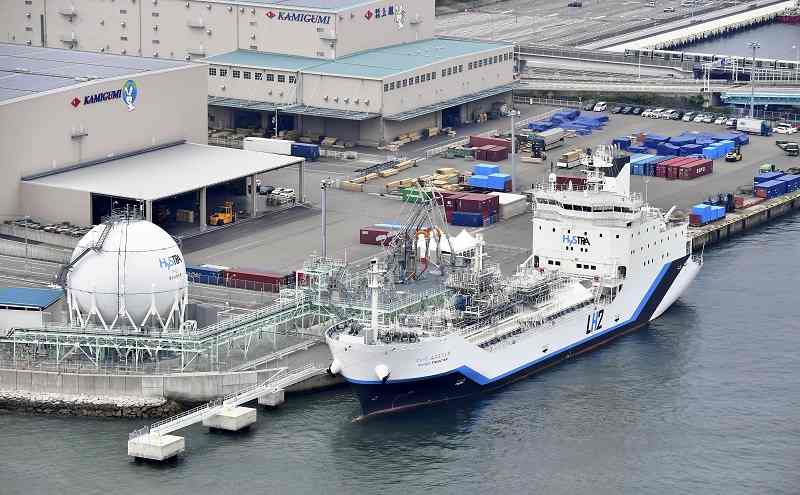
The Suiso Frontier, the world’s first liquefied hydrogen carrier, is seen docked at Kobe Port in May last year.
1:00 JST, August 31, 2022
The government is planning to build ports capable of accepting hydrogen tankers.
As the world strives toward decarbonization, demand for hydrogen is expected to increase in such fields as power generation and transportation. To ensure a stable supply of hydrogen, the government plans to include a policy to build a maritime transport network in the Basic Plan on Ocean Policy to be revised around May next year.
Founded on the Basic Act on Ocean Policy established in 2007, the Basic Plan on Ocean Policy lays out a comprehensive set of maritime measures for implementation. In principle, the plan is revised every five years or so — the current plan was adopted in May 2018.
Japan aims to cut greenhouse gas emissions by 46% by fiscal 2030 based on 2013 levels and achieve carbon neutrality by effectively reducing emissions to zero by 2050. The government, which expects hydrogen to become a next-generation fuel because it does not produce greenhouse gases when burned, aims to increase annual hydrogen consumption to 20 million tons by 2050 from its current figure of 2 million tons.
Cost-cutting remains a challenge, however. The Natural Resources and Energy Agency estimates that it currently costs about ¥170 to procure a cubic meter of hydrogen, but the government wants to slash this number some 80% to ¥30 by 2030. To that end, it is necessary to develop a supply chain to enable stable procurement of hydrogen on a large scale.
As a possible model, the government is looking at a demonstration experiment conducted by CO2-free Hydrogen Energy Supply-chain Technology Research Association (HySTRA), comprising Kawasaki Heavy Industries Ltd., Iwatani Corp. and other companies. In February, HySTRA transported liquefied hydrogen produced in Australia to Kobe Port using a hydrogen carrier with a tank capacity of 1,250 cubic meters. The experiment marked the first-ever large-scale conveyance of liquefied hydrogen by sea in the world.
According to the Land, Infrastructure, Transport and Tourism Ministry, Kobe Port is the only port in Japan presently capable of handling hydrogen tankers. The government is thus asking port-managing municipalities across the country to estimate their future hydrogen demands and will base its future development plans on the municipalities’ reports, local conditions and other factors.




Most Read
Most read in the last 24 hours
-
Shifts Startup Focus to Nurturing Global Winners
-

Princess Aiko Enjoys Imperial Court Music, Dance; Production, Cos...
-

Bibimbap with Spring Vegetables and Asari Clam Miso a Rich Taste ...
-

Mother Supports My Sister Too Much, Gives Her Kids Much More Than...
-
Umami History: Kyoto Chef Murata Worked to Share Japan’s Scientif...
-

Appeal of Japanese Food: Make Good Use of ‘Discoveries’ by People...
-
Official App to Help Startups Meet Other Participants
-

Okinawa Gubernatorial Election: Candidates Should Advocate Realis...
Most read in the last 7 days
-
Earthquake Hits Japan's Tohoku Region; 3-meter Tsunami Warning Is...
-

China, South Korea Object to Japanese PM Takaichi's Ritual Offeri...
-

Trump Extends the Ceasefire with Iran but Keeps the Blockade
-

India's Arms Indigenization Quest for Self-Reliance / New Delhi S...
-

¥1,000 Coins to Be Issued to Mark Anniversary of Beginning of Jap...
-

Most Serious Cyberattacks against the UK Now from Russia, Iran an...
-

Trump Opposes United–American Merger, Signals Support for Spirit
-
System Malfunction in Haneda Airport Causes 83 Flight Cancelation...
Most read in the last 30 days
-
Earthquake Hits Japan's Tohoku Region; 3-meter Tsunami Warning Is...
-
Police Find Child's Shoe During Search for Missing Boy in Nantan,...
-

Body Found in Nantan, Kyoto Prefecture, During Search for 11-Year...
-
China, South Korea Object to Japanese PM Takaichi's Ritual Offeri...
-
Cherry Blossoms, Rapeseed Flowers Perform Colorful ‘Duet’ in Niig...
-
Trump Extends the Ceasefire with Iran but Keeps the Blockade
-

Olympic Gold Medal-Winning Figure Skaters Riku-Ryu Announce Retir...
-
Japanese Prime Minister Takaichi Speaks to Pakistani Prime Minist...
Top Articles in Science & Nature
-

Govt Aims to Establish Bear Population Control by FY30, Hopes to Achieve ‘Coexistence’ with Bears
-
Japan’s Panasonic Develops Automated System to Produce Ips Cells from Patient’s Blood
-

Punch The Monkey Getting Used to Life Without Stuffed ‘Mother’
-

‘Electric Aircraft’ to Begin Test Flights from Kitakyushu Airport, Aiming for Practical Use in Cargo Transport Route
-
New Robotics Center to Conduct Experiments Around the Clock; New Facility Aims to Accelerate Research Efforts
JN ACCESS RANKING
-
Earthquake Hits Japan’s Tohoku Region; 3-meter Tsunami Warning Issued (Update 1)
-
Police Find Child’s Shoe During Search for Missing Boy in Nantan, Kyoto Prefecture
-
Body Found in Nantan, Kyoto Prefecture, During Search for 11-Year-Old Boy in Area (Update 1)
-
China, South Korea Object to Japanese PM Takaichi’s Ritual Offering to Yasukuni Shrine
-
Cherry Blossoms, Rapeseed Flowers Perform Colorful ‘Duet’ in Niigata
Most read in the last 24 hours
-
Shifts Startup Focus to Nurturing Global Winners
-
Princess Aiko Enjoys Imperial Court Music, Dance; Production, Cos...
-
Bibimbap with Spring Vegetables and Asari Clam Miso a Rich Taste ...
-
Mother Supports My Sister Too Much, Gives Her Kids Much More Than...
-
Umami History: Kyoto Chef Murata Worked to Share Japan’s Scientif...
Most read in the last 7 days
-
Earthquake Hits Japan's Tohoku Region; 3-meter Tsunami Warning Is...
-
China, South Korea Object to Japanese PM Takaichi's Ritual Offeri...
-
Trump Extends the Ceasefire with Iran but Keeps the Blockade
-
India's Arms Indigenization Quest for Self-Reliance / New Delhi S...
-
¥1,000 Coins to Be Issued to Mark Anniversary of Beginning of Jap...
Most read in the last 30 days
-
Earthquake Hits Japan's Tohoku Region; 3-meter Tsunami Warning Is...
-
Police Find Child's Shoe During Search for Missing Boy in Nantan,...
-
Body Found in Nantan, Kyoto Prefecture, During Search for 11-Year...
-
China, South Korea Object to Japanese PM Takaichi's Ritual Offeri...
-
Cherry Blossoms, Rapeseed Flowers Perform Colorful ‘Duet’ in Niig...