
Samurai Japan’s Quest for Back-to-Back WBC Titles Ends at Quarterfinal Stage in 5-8 Loss to Venezuela

Shohei Ohtani flies out to shortstop in the final play against Venezuela in Miami on Saturday.
18:10 JST, March 16, 2026
MIAMI — Samurai Japan’s quest for a back-to-back World Baseball Classic title ended Saturday, after Venezuela came from behind to win their quarterfinal match-up 8-5.
It is the first time for Japan – winners of the inaugural 2006 tournament, as well as the 2009 and 2023 editions – to fail to advance to the semifinals in the six WBC campaigns.
Wilyer Abreu’s three-run homer deep over the right wall in the sixth off Hiromi Ito, Samurai Japan’s fourth pitcher of the night, put Venezuela up 7-5. Japan had been up 5-2 before Maikel Garcia’s two-run homer in the fifth.
Hanshin Tigers outfielder Shota Morishita hit a three-run homer in the third. He had been substituted into the game after Chicago Cubs outfielder Seiya Suzuki was injured in the first inning.
Both teams started the game with lead-off home runs. Los Angeles Dodgers two-way star Shohei Ohtani’s solo shot over the centerfield canceled out Atlanta Braves outfielder Ronald Acuna Jr.’s homer off starter Yoshinobu Yamamoto.
In the third inning, Hanshin Tigers infielder Teruaki Sato hit a one-run double to again tie the game 2-2.
Following Morishita’s three-run play, Samurai Japan failed to score, managing just three hits for the rest of the game.
The result was sealed when Ohtani ended his WBC campaign with a fly out to shortstop.
“Anything short of winning the championship is failure,” Ohtani said after the game. “I’m so disappointed that it ended up like this.”
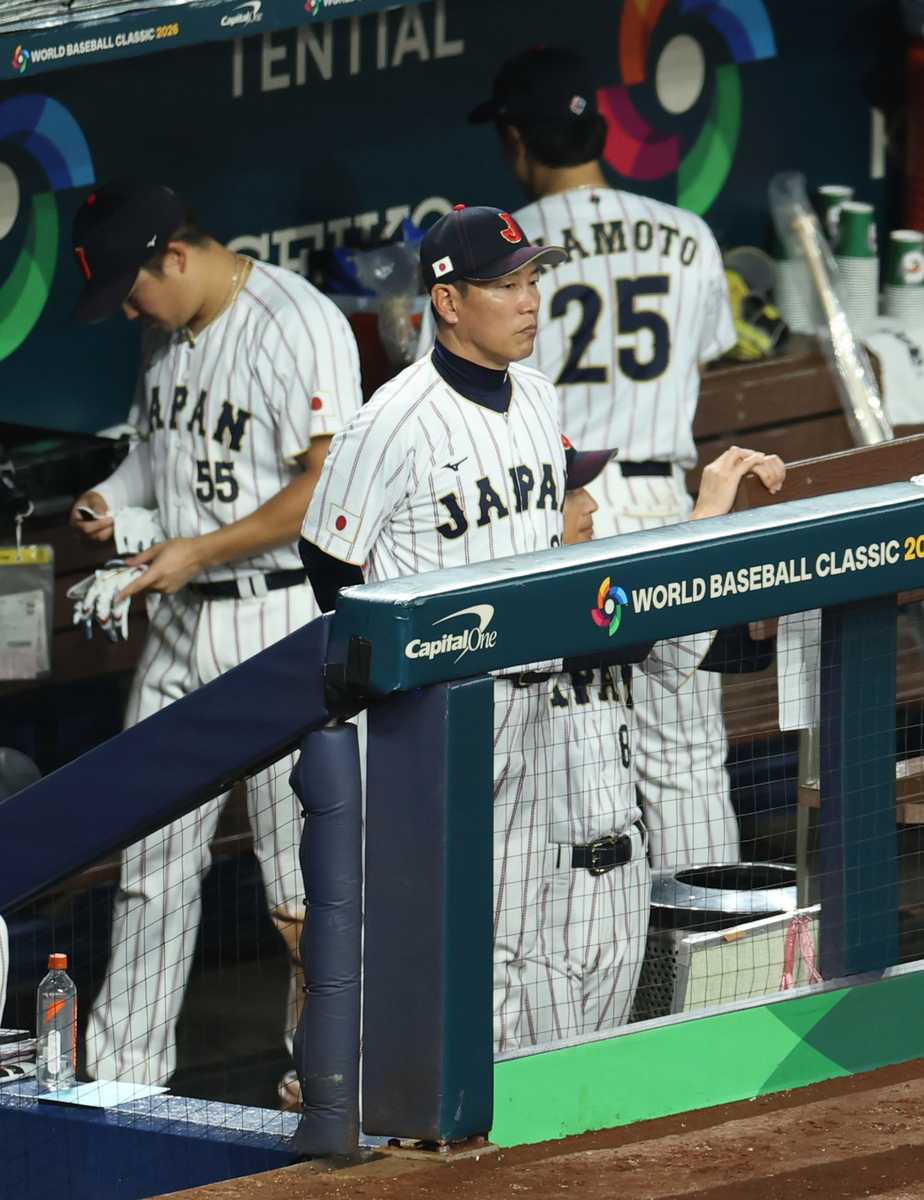
Samurai Japan skipper Hirokazu Ibata stares at the field after his team lost to Venezuela in Miami on Saturday.
Ibata thankful to players
MIAMI — Following Samurai Japan’s exit from the World Baseball Classic in Miami on Saturday, skipper Hirokazu Ibata has expressed his intention to step down as Japan manager after the current tournament wraps up.
“I sent them to the mound with confidence,” Ibata said, paying consideration to the pitchers who appeared in the quarterfinal against Venezuela. “They did a fine job.”
Ibata was seen watching players from a position between third and shortstop during the pre-game practice. He had played under legendary managers such as Senichi Hoshino, Hiromitsu Ochiai and Tatsunori Hara. When he was named to steer Samurai Japan, Ibata decided to “adopt good aspects of those managers.” And he noticed the three had one thing in common, which was observing their players meticulously.
As a player, Ibata mostly played shortstop. He therefore feels comfortable watching the players from that position, which became his routine during practice sessions.
One reason for him observing the players is to protect them. If he noticed something strange about a player’s facial expression or movement, Ibata would stop that player practicing.
“Players, including myself [while an active player], tend to push themselves over the limit,” Ibata said. “We should notice what players do not say.” When pitchers practice for conditioning on an off day, Ibata would show up even when he was tired.
The manager that most influenced Ibata was the late Shigeo Nagashima. Nagashima and Ibata competed together as skipper and player for Samurai Japan in the qualifying games for the 2004 Athens Olympics. “He was a man serious about winning,” Ibata said of Nagashima, who died in June last year.
When Ibata took over as manager of Samurai Japan in October 2023 from Hideki Kuriyama, Nagashima encouraged him over the phone, “Build a new Japan in your own style.”
During the farewell ceremony for Nagashima in November, Ibata expressed his determination, “I want to show the fans good games during the WBC, focusing on winning.”


Related Tags






Most Read
Most read in the last 24 hours
-

India’s Arms Indigenization Quest for Self-Reliance / Big Firms, ...
-

Japan Moves Closer to Blocking Illegal Online Casinos as Governme...
-

Shifts Startup Focus to Nurturing Global Winners
-
Princess Aiko Enjoys Imperial Court Music, Dance; Production, Cos...
-

Bibimbap with Spring Vegetables and Asari Clam Miso a Rich Taste ...
-
Official App to Help Startups Meet Other Participants
-

Mother Supports My Sister Too Much, Gives Her Kids Much More Than...
-

Umami History: Kyoto Chef Murata Worked to Share Japan’s Scientif...
Most read in the last 7 days
-
Earthquake Hits Japan's Tohoku Region; 3-meter Tsunami Warning Is...
-

China, South Korea Object to Japanese PM Takaichi's Ritual Offeri...
-

Trump Extends the Ceasefire with Iran but Keeps the Blockade
-

India's Arms Indigenization Quest for Self-Reliance / New Delhi S...
-

¥1,000 Coins to Be Issued to Mark Anniversary of Beginning of Jap...
-

Most Serious Cyberattacks against the UK Now from Russia, Iran an...
-

Trump Opposes United–American Merger, Signals Support for Spirit
-

System Malfunction in Haneda Airport Causes 83 Flight Cancelation...
Most read in the last 30 days
-
Earthquake Hits Japan's Tohoku Region; 3-meter Tsunami Warning Is...
-
Police Find Child's Shoe During Search for Missing Boy in Nantan,...
-
Body Found in Nantan, Kyoto Prefecture, During Search for 11-Year...
-
Cherry Blossoms, Rapeseed Flowers Perform Colorful ‘Duet’ in Niig...
-
China, South Korea Object to Japanese PM Takaichi's Ritual Offeri...
-
Trump Extends the Ceasefire with Iran but Keeps the Blockade
-

Olympic Gold Medal-Winning Figure Skaters Riku-Ryu Announce Retir...
-

Japanese Prime Minister Takaichi Speaks to Pakistani Prime Minist...
Top Articles in Sports
-
Olympic Gold Medal-Winning Figure Skaters Riku-Ryu Announce Retirement (Update 1)
-
New Challenges Await as Miura-Kihara Retires; Blade Maker, Ex-Coach Share Memories
-

White Sox Rookie Munetaka Murakami Ties MLB Rookie Record with HR in 5th Straight Game
-

Milano Cortina 2026: Miura, Kihara Among Participants at Tokyo Parade for Winter Olympic Athletes
-

Shohei Ohtani’s 53-Game on-Base Streak Ends as Roberts Mulls Resting Him More Often When He Pitches
JN ACCESS RANKING
-
Earthquake Hits Japan’s Tohoku Region; 3-meter Tsunami Warning Issued (Update 1)
-
Police Find Child’s Shoe During Search for Missing Boy in Nantan, Kyoto Prefecture
-
Body Found in Nantan, Kyoto Prefecture, During Search for 11-Year-Old Boy in Area (Update 1)
-
Cherry Blossoms, Rapeseed Flowers Perform Colorful ‘Duet’ in Niigata
-
China, South Korea Object to Japanese PM Takaichi’s Ritual Offering to Yasukuni Shrine
Most read in the last 24 hours
-
India’s Arms Indigenization Quest for Self-Reliance / Big Firms, ...
-
Japan Moves Closer to Blocking Illegal Online Casinos as Governme...
-
Shifts Startup Focus to Nurturing Global Winners
-
Princess Aiko Enjoys Imperial Court Music, Dance; Production, Cos...
-
Bibimbap with Spring Vegetables and Asari Clam Miso a Rich Taste ...
Most read in the last 7 days
-
Earthquake Hits Japan's Tohoku Region; 3-meter Tsunami Warning Is...
-
China, South Korea Object to Japanese PM Takaichi's Ritual Offeri...
-
Trump Extends the Ceasefire with Iran but Keeps the Blockade
-
India's Arms Indigenization Quest for Self-Reliance / New Delhi S...
-
¥1,000 Coins to Be Issued to Mark Anniversary of Beginning of Jap...
Most read in the last 30 days
-
Earthquake Hits Japan's Tohoku Region; 3-meter Tsunami Warning Is...
-
Police Find Child's Shoe During Search for Missing Boy in Nantan,...
-
Body Found in Nantan, Kyoto Prefecture, During Search for 11-Year...
-
Cherry Blossoms, Rapeseed Flowers Perform Colorful ‘Duet’ in Niig...
-
China, South Korea Object to Japanese PM Takaichi's Ritual Offeri...