
China and Philippines Use Their Flags to Stake out Competing Claims in the South China Sea
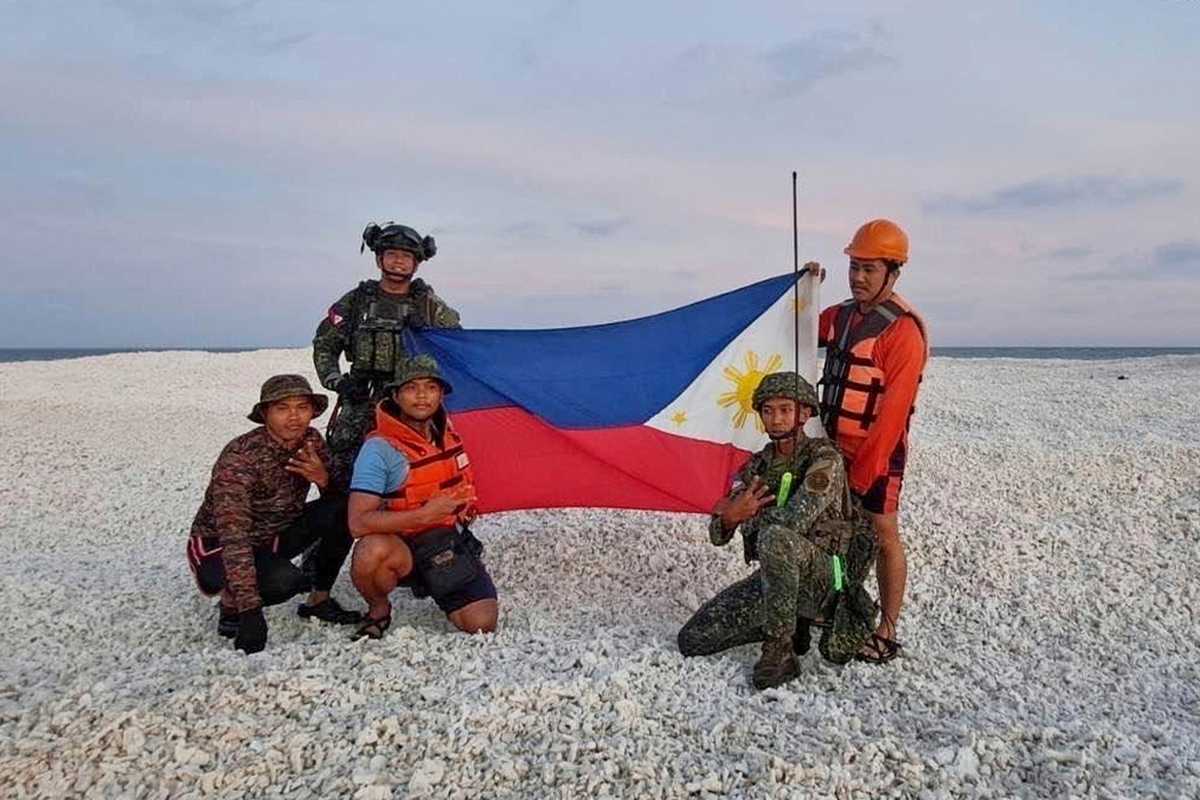
Philippine Coast Guard and Philippine National Police – Maritime Group, hold the Philippine flag as they visit Sandy Cay 2 at the South China Sea on Sunday April 27, 2025.
11:13 JST, April 29, 2025
BEIJING (AP) — The Philippines on Monday rejected China’s claim to a group of three sandbars in the South China Sea, after recent displays by both sides of their national flags on the uninhabited outcroppings.
The back and forth over Sandy Cay is the latest flare-up in a long-running dispute over territory in the hotly contested South China Sea, which China claims almost in its entirety.
The flare-up began last week when a Chinese state-owned newspaper posted exclusive photos of coast guard officers on Sandy Cay from mid-April, including one of them holding up a Chinese flag.
Three days later, a joint Philippines coast guard, navy and maritime police team headed on Sunday to the three sandbars and posed for a photo holding up their national flag.
“This operation reflects the unwavering dedication and commitment of the Philippine Government to uphold the country’s sovereignty, sovereign rights and jurisdiction in the West Philippine Sea,” a government statement said. It was posted on X with a video and photos, including one showing team members holding up the Philippine flag.
The Chinese coast guard described the Philippine landing as “illegal” and said that Chinese officers had gone ashore “to conduct on-site verification and enforcement measures.” It didn’t specify what those steps entailed.
The sandbars are in the Spratly islands between Philippine-occupied Thitu Island and Subi Reef, which China has transformed into a base with a military-grade runway and buildings with communications facilities.
China’s state-owned Global Times newspaper, which published the photos of coast guard officers on the sandbars earlier this month, said they had picked up plastic bottles and other debris and displayed the Chinese national flag “to assert sovereignty.”
Jonathan Malaya, the assistant director general of the Philippine National Security Council, said Monday that there is no truth to claims that China has seized the sandbars.
He attributed the claims to the Chinese coast guard, though the agency has not said anything about the mid-April landing described in the Global Times report, and later by the military channel of state broadcaster CCTV.
“We urge the People’s Republic of China and the Chinese Coast Guard to act with restraint and not increase tensions in the West Philippine Sea,” Malaya told a news conference,
The two countries have jostled previously over Sandy Cay, known as Tiexian Reef in Chinese and Pag-asa Cays in the Philippines.
In January, the Chinese coast guard and a naval helicopter drove away a group of Philippines fisheries ships that were attempting to conduct a scientific survey around Sandy Cay.
Philippine government vessels brought scientists to Sandy Cay in March of last year for marine research despite repeated warnings by Chinese coast guard ships.
Chinese officials accused the Philippine military of attempting to build a structure on one of the sandbars in 2017.







Most Read
Most read in the last 24 hours
-

Shifts Startup Focus to Nurturing Global Winners
-

Princess Aiko Enjoys Imperial Court Music, Dance; Production, Cos...
-

Mother Supports My Sister Too Much, Gives Her Kids Much More Than...
-

Bibimbap with Spring Vegetables and Asari Clam Miso a Rich Taste ...
-

Umami History: Kyoto Chef Murata Worked to Share Japan’s Scientif...
-

Appeal of Japanese Food: Make Good Use of ‘Discoveries’ by People...
-

Okinawa Gubernatorial Election: Candidates Should Advocate Realis...
-
Official App to Help Startups Meet Other Participants
Most read in the last 7 days
-
Earthquake Hits Japan's Tohoku Region; 3-meter Tsunami Warning Is...
-

China, South Korea Object to Japanese PM Takaichi's Ritual Offeri...
-

Trump Extends the Ceasefire with Iran but Keeps the Blockade
-

India's Arms Indigenization Quest for Self-Reliance / New Delhi S...
-

¥1,000 Coins to Be Issued to Mark Anniversary of Beginning of Jap...
-

Most Serious Cyberattacks against the UK Now from Russia, Iran an...
-

Trump Opposes United–American Merger, Signals Support for Spirit
-

System Malfunction in Haneda Airport Causes 83 Flight Cancelation...
Most read in the last 30 days
-
Earthquake Hits Japan's Tohoku Region; 3-meter Tsunami Warning Is...
-

Police Find Child's Shoe During Search for Missing Boy in Nantan,...
-

Body Found in Nantan, Kyoto Prefecture, During Search for 11-Year...
-
China, South Korea Object to Japanese PM Takaichi's Ritual Offeri...
-

Cherry Blossoms, Rapeseed Flowers Perform Colorful ‘Duet’ in Niig...
-
Trump Extends the Ceasefire with Iran but Keeps the Blockade
-

Olympic Gold Medal-Winning Figure Skaters Riku-Ryu Announce Retir...
-

Japanese Prime Minister Takaichi Speaks to Pakistani Prime Minist...
Top Articles in News Services
-
Trump Extends the Ceasefire with Iran but Keeps the Blockade
-
Most Serious Cyberattacks against the UK Now from Russia, Iran and China, Cyber Chief Says
-
Trump Opposes United–American Merger, Signals Support for Spirit
-

Florida Launches Criminal Probe into OpenAI and ChatGPT over Deadly Shooting
-

Trump Picks a University of Minnesota Professor to Lead His Economic Council
JN ACCESS RANKING
-
Earthquake Hits Japan’s Tohoku Region; 3-meter Tsunami Warning Issued (Update 1)
-
Police Find Child’s Shoe During Search for Missing Boy in Nantan, Kyoto Prefecture
-
Body Found in Nantan, Kyoto Prefecture, During Search for 11-Year-Old Boy in Area (Update 1)
-
China, South Korea Object to Japanese PM Takaichi’s Ritual Offering to Yasukuni Shrine
-
Cherry Blossoms, Rapeseed Flowers Perform Colorful ‘Duet’ in Niigata
Most read in the last 24 hours
-
Shifts Startup Focus to Nurturing Global Winners
-
Princess Aiko Enjoys Imperial Court Music, Dance; Production, Cos...
-
Mother Supports My Sister Too Much, Gives Her Kids Much More Than...
-
Bibimbap with Spring Vegetables and Asari Clam Miso a Rich Taste ...
-
Umami History: Kyoto Chef Murata Worked to Share Japan’s Scientif...
Most read in the last 7 days
-
Earthquake Hits Japan's Tohoku Region; 3-meter Tsunami Warning Is...
-
China, South Korea Object to Japanese PM Takaichi's Ritual Offeri...
-
Trump Extends the Ceasefire with Iran but Keeps the Blockade
-
India's Arms Indigenization Quest for Self-Reliance / New Delhi S...
-
¥1,000 Coins to Be Issued to Mark Anniversary of Beginning of Jap...
Most read in the last 30 days
-
Earthquake Hits Japan's Tohoku Region; 3-meter Tsunami Warning Is...
-
Police Find Child's Shoe During Search for Missing Boy in Nantan,...
-
Body Found in Nantan, Kyoto Prefecture, During Search for 11-Year...
-
China, South Korea Object to Japanese PM Takaichi's Ritual Offeri...
-
Cherry Blossoms, Rapeseed Flowers Perform Colorful ‘Duet’ in Niig...