
Himalayan Glaciers Could Lose 80% of Their Volume If Global Warming Not Controlled, Study Finds
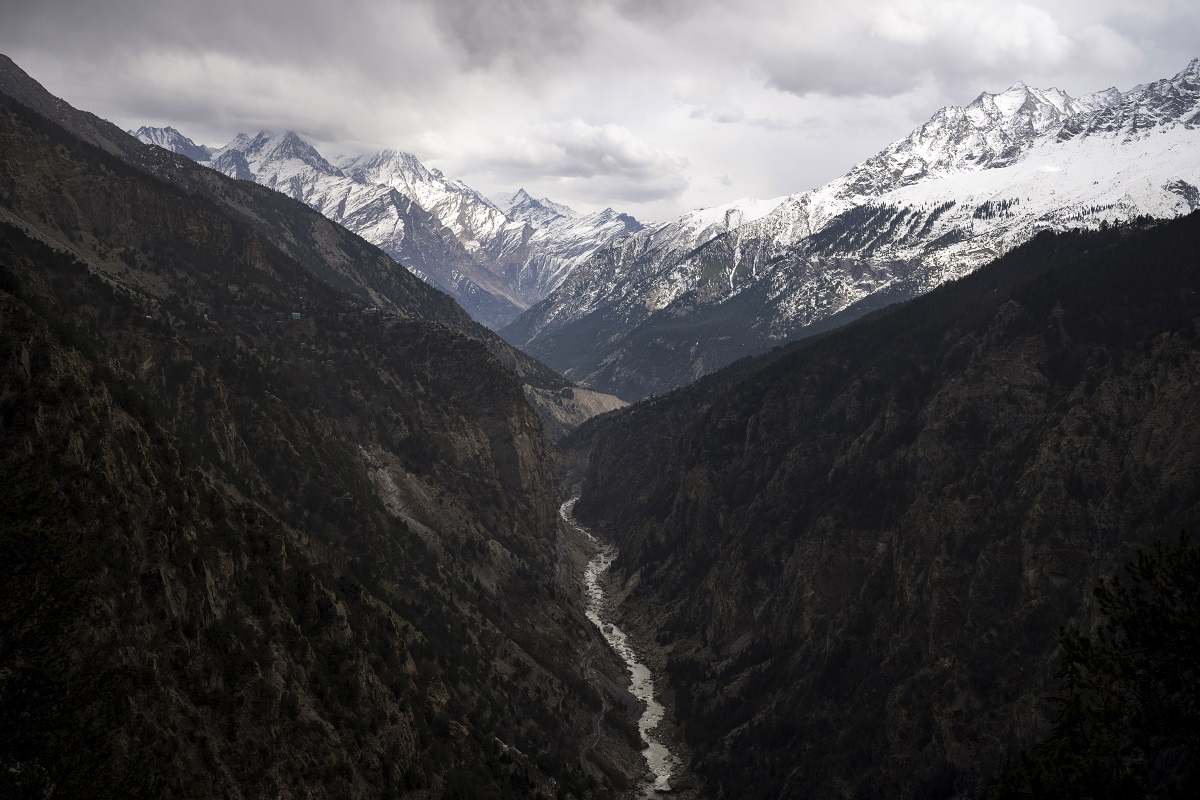
The Sutlej River flows in the valley below the tall snowy peaks in the Kinnaur district of the Himalayan state of Himachal Pradesh, India, March 13, 2023.
11:09 JST, June 20, 2023
BENGALURU, India (AP) — Glaciers are melting at unprecedented rates across the Hindu Kush Himalayan mountain ranges and could lose up to 80% of their current volume this century if greenhouse gas emissions aren’t sharply reduced, according to a new report.
The report Tuesday from Kathmandu-based International Centre for Integrated Mountain Development warned that flash floods and avalanches would grow more likely in coming years, and that the availability of fresh water would be affected for nearly 2 billion people who live downstream of 12 rivers that originate in the mountains.
Ice and snow in the Hindu Kush Himalayan ranges is an important source of water for those rivers, which flow through 16 countries in Asia and provide fresh water to 240 million people in the mountains and anther 1.65 billion downstream.
“The people living in these mountains who have contributed next to nothing to global warming are at high risk due to climate change,” said Amina Maharjan, a migration specialist and one of the report’s authors. “Current adaptation efforts are wholly insufficient, and we are extremely concerned that without greater support, these communities will be unable to cope.”
Various earlier reports have found that the cryosphere — regions on Earth covered by snow and ice — are among the worst affected by climate change. Recent research found that Mount Everest’s glaciers, for example, have lost 2,000 years of ice in just the past 30 years.
“We map out for the first time the linkages between cryosphere change with water, ecosystems and society in this mountain region,” Maharjan said.
Among the key findings from Tuesday’s report are that the Himalayan glaciers disappeared 65% faster since 2010 than in the previous decade and reducing snow cover due to global warming will result in reduced fresh water for people living downstream. The study found that 200 glacier lakes across these mountains are deemed dangerous, and the region could see a significant spike in glacial lake outburst floods by the end of the century.
The study found that communities in the mountain regions are being affected by climate change far more than many other parts of the world. It says changes to the glaciers, snow and permafrost of the Hindu Kush Himalayan region driven by global warming are “unprecedented and largely irreversible.”
Effects of climate change are already felt by Himalayan communities sometimes acutely. Earlier this year the Indian mountain town of Joshimath began sinking and residents had to be relocated within days.
“Once ice melts in these regions, it’s very difficult to put it back to its frozen form,” said Pam Pearson, director of the International Cryosphere Climate Initiative, who was not involved with the report.
She added, “It’s like a big ship in the ocean. Once the ice starts going, it’s very hard to stop. So, with glaciers, especially the big glaciers in the Himalayas, once they start losing mass, that’s going to continue for a really long time before it can stabilize.”
Pearson said it is extremely important for Earth’s snow, permafrost and ice to limit warming to the 1.5 degrees Celsius agreed to at the 2015 Paris climate conference.
“I get the sense that most policymakers don’t take the goal seriously but, in the cryosphere, irreversible changes are already happening,” she said.








Most Read
Most read in the last 24 hours
-

India’s Arms Indigenization Quest for Self-Reliance / Big Firms, ...
-

Shifts Startup Focus to Nurturing Global Winners
-

Princess Aiko Enjoys Imperial Court Music, Dance; Production, Cos...
-

Bibimbap with Spring Vegetables and Asari Clam Miso a Rich Taste ...
-

Mother Supports My Sister Too Much, Gives Her Kids Much More Than...
-

Official App to Help Startups Meet Other Participants
-

Umami History: Kyoto Chef Murata Worked to Share Japan’s Scientif...
-

Appeal of Japanese Food: Make Good Use of ‘Discoveries’ by People...
Most read in the last 7 days
-
Earthquake Hits Japan's Tohoku Region; 3-meter Tsunami Warning Is...
-

China, South Korea Object to Japanese PM Takaichi's Ritual Offeri...
-

Trump Extends the Ceasefire with Iran but Keeps the Blockade
-

India's Arms Indigenization Quest for Self-Reliance / New Delhi S...
-

¥1,000 Coins to Be Issued to Mark Anniversary of Beginning of Jap...
-

Most Serious Cyberattacks against the UK Now from Russia, Iran an...
-

Trump Opposes United–American Merger, Signals Support for Spirit
-

System Malfunction in Haneda Airport Causes 83 Flight Cancelation...
Most read in the last 30 days
-
Earthquake Hits Japan's Tohoku Region; 3-meter Tsunami Warning Is...
-
Police Find Child's Shoe During Search for Missing Boy in Nantan,...
-
Body Found in Nantan, Kyoto Prefecture, During Search for 11-Year...
-
Cherry Blossoms, Rapeseed Flowers Perform Colorful ‘Duet’ in Niig...
-
China, South Korea Object to Japanese PM Takaichi's Ritual Offeri...
-
Trump Extends the Ceasefire with Iran but Keeps the Blockade
-

Olympic Gold Medal-Winning Figure Skaters Riku-Ryu Announce Retir...
-

Japanese Prime Minister Takaichi Speaks to Pakistani Prime Minist...
Top Articles in News Services
-
Trump Extends the Ceasefire with Iran but Keeps the Blockade
-
Most Serious Cyberattacks against the UK Now from Russia, Iran and China, Cyber Chief Says
-
Trump Opposes United–American Merger, Signals Support for Spirit
-

Florida Launches Criminal Probe into OpenAI and ChatGPT over Deadly Shooting
-

Trump Picks a University of Minnesota Professor to Lead His Economic Council
JN ACCESS RANKING
-
Earthquake Hits Japan’s Tohoku Region; 3-meter Tsunami Warning Issued (Update 1)
-
Police Find Child’s Shoe During Search for Missing Boy in Nantan, Kyoto Prefecture
-
Body Found in Nantan, Kyoto Prefecture, During Search for 11-Year-Old Boy in Area (Update 1)
-
Cherry Blossoms, Rapeseed Flowers Perform Colorful ‘Duet’ in Niigata
-
China, South Korea Object to Japanese PM Takaichi’s Ritual Offering to Yasukuni Shrine
Most read in the last 24 hours
-
India’s Arms Indigenization Quest for Self-Reliance / Big Firms, ...
-
Shifts Startup Focus to Nurturing Global Winners
-
Princess Aiko Enjoys Imperial Court Music, Dance; Production, Cos...
-
Bibimbap with Spring Vegetables and Asari Clam Miso a Rich Taste ...
-
Mother Supports My Sister Too Much, Gives Her Kids Much More Than...
Most read in the last 7 days
-
Earthquake Hits Japan's Tohoku Region; 3-meter Tsunami Warning Is...
-
China, South Korea Object to Japanese PM Takaichi's Ritual Offeri...
-
Trump Extends the Ceasefire with Iran but Keeps the Blockade
-
India's Arms Indigenization Quest for Self-Reliance / New Delhi S...
-
¥1,000 Coins to Be Issued to Mark Anniversary of Beginning of Jap...
Most read in the last 30 days
-
Earthquake Hits Japan's Tohoku Region; 3-meter Tsunami Warning Is...
-
Police Find Child's Shoe During Search for Missing Boy in Nantan,...
-
Body Found in Nantan, Kyoto Prefecture, During Search for 11-Year...
-
Cherry Blossoms, Rapeseed Flowers Perform Colorful ‘Duet’ in Niig...
-
China, South Korea Object to Japanese PM Takaichi's Ritual Offeri...