
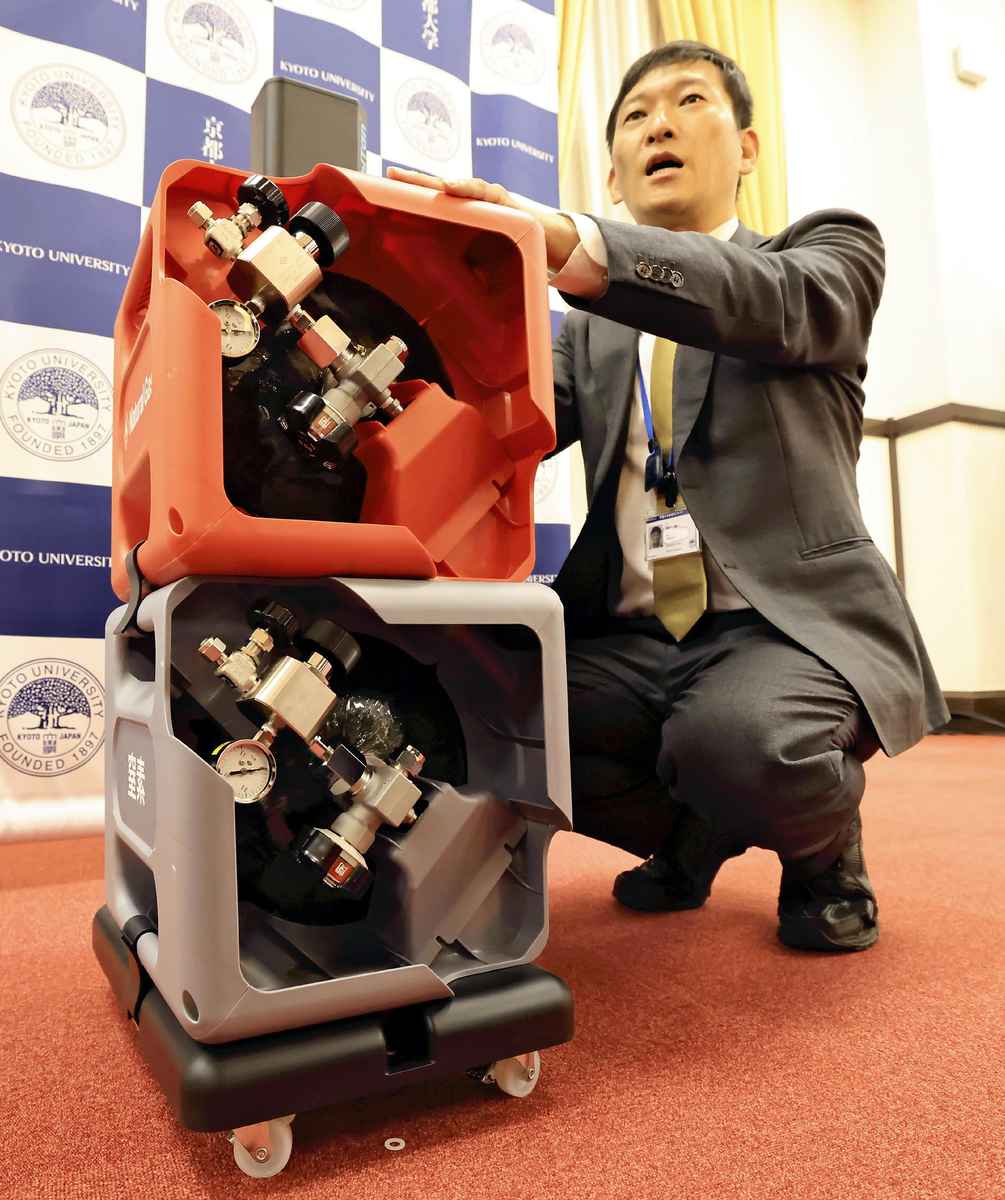
CubiTans, advanced high-pressure gas containers designed for efficient gas storage, are seen in Sakyo Ward, Kyoto, on Wednesday.
15:08 JST, October 9, 2025
Metal-organic frameworks (MOFs) are starting to see real-world use both in Japan and aboard, thanks primarily to the efforts of startups. Kyoto University Distinguished Prof. Susumu Kitagawa won the Nobel Prize in Chemistry on Wednesday for their work in the development of MOFs.
In 2015, former staff of Kitagawa’s laboratory, along with others, established the Kobe-based Atomis Inc., a Kyoto University spin-off focused on developing products using MOFs. The firm developed CubiTan, an advanced high-pressure gas container for more efficient gas storage and distribution, taking advantage of the MOF’s ability to absorb large amounts of gas. CubiTan was exhibited at the 2025 Osaka-Kansai Expo.
By working with Atomis, Nippon Fusso Co. in Sakai, Osaka Prefecture, commercialized a fluororesin coating technology that incorporates MOFs in 2020. When this coating is used inside metal tanks for storing acids, the MOFs absorb the acid, improving the tanks’ corrosion resistance.
“Much time has passed since Kitagawa’s 1997 paper, but we have finally been able to commercialize it in Japan,” said Atomis founder Masakazu Higuchi. Higuchi is an associate professor at the university and has been doing research under Kitagawa for many years.
In 2016, British startup MOF Technologies Ltd., also known as Nuada, developed a product using MOFs to store and release a gas that prolongs the life of fruits and vegetables. This is thought to be the world’s first commercial use of MOFs.
A technology for capturing carbon dioxide, a greenhouse gas, is also attracting attention. The devices, developed by Canadian startup Svante Technologies Inc., capture CO2 from emissions at cement plants and similar facilities.
In February 2024, major city gas provider Toho Gas Co. based in Nagoya began testing similar devices at a facility in Aichi Prefecture, as it aims to create a technology for capturing CO2 from factory emissions.
According to Higuchi, at least 51 MOF-related startups have been launched worldwide. “Social implementation of MOF-related technology has been steadily progressing,” he said, “primarily thanks to the efforts of startups, and the pace is likely to pick up.”


Related Tags




Most Read
Most read in the last 24 hours
-

Trump Extends the Ceasefire with Iran but Keeps the Blockade
-

China, South Korea Object to Japanese PM Takaichi's Ritual Offeri...
-

Florida Launches Criminal Probe into OpenAI and ChatGPT over Dead...
-

Trump Opposes United–American Merger, Signals Support for Spirit
-

Trump Picks a University of Minnesota Professor to Lead His Econo...
-

Japan's ANA to Introduce Fuel Surcharges to Domestic Flights from...
-

Taiwan President Cancels Africa Trip Blaming Chinese Pressure
-

Fired Former UK Official Says He Felt Political Pressure to Appro...
Most read in the last 7 days
-
Earthquake Hits Japan's Tohoku Region; 3-meter Tsunami Warning Is...
-
Trump Extends the Ceasefire with Iran but Keeps the Blockade
-

Olympic Gold Medal-Winning Figure Skaters Riku-Ryu Announce Retir...
-
China, South Korea Object to Japanese PM Takaichi's Ritual Offeri...
-

Japan to Ban Use of Portable Chargers on Airplanes from April 24,...
-
New Challenges Await as Miura-Kihara Retires; Blade Maker, Ex-Coa...
-
Florida Launches Criminal Probe into OpenAI and ChatGPT over Dead...
-
Trump Opposes United–American Merger, Signals Support for Spirit
Most read in the last 30 days
-
Earthquake Hits Japan's Tohoku Region; 3-meter Tsunami Warning Is...
-

Police Find Child's Shoe During Search for Missing Boy in Nantan,...
-

Body Found in Nantan, Kyoto Prefecture, During Search for 11-Year...
-

Cherry Blossoms, Rapeseed Flowers Perform Colorful ‘Duet’ in Niig...
-
Trump Extends the Ceasefire with Iran but Keeps the Blockade
-
Olympic Gold Medal-Winning Figure Skaters Riku-Ryu Announce Retir...
-

Nori Prices Surge in Japan Due to Poor Seaweed Production Amid Ri...
-
Japanese Prime Minister Takaichi Speaks to Pakistani Prime Minist...
Top Articles in Science & Nature
-

Govt Aims to Establish Bear Population Control by FY30, Hopes to Achieve ‘Coexistence’ with Bears
-

Punch The Monkey Getting Used to Life Without Stuffed ‘Mother’
-

‘Electric Aircraft’ to Begin Test Flights from Kitakyushu Airport, Aiming for Practical Use in Cargo Transport Route
-

New Robotics Center to Conduct Experiments Around the Clock; New Facility Aims to Accelerate Research Efforts
-

Tokyo Govt to Encourage Offshore Wind Power by Surveying Seabed near Izu Islands
JN ACCESS RANKING
-
Earthquake Hits Japan’s Tohoku Region; 3-meter Tsunami Warning Issued (Update 1)
-
Police Find Child’s Shoe During Search for Missing Boy in Nantan, Kyoto Prefecture
-
Body Found in Nantan, Kyoto Prefecture, During Search for 11-Year-Old Boy in Area (Update 1)
-
Cherry Blossoms, Rapeseed Flowers Perform Colorful ‘Duet’ in Niigata
-
Trump Extends the Ceasefire with Iran but Keeps the Blockade
Most read in the last 24 hours
-
Trump Extends the Ceasefire with Iran but Keeps the Blockade
-
China, South Korea Object to Japanese PM Takaichi's Ritual Offeri...
-
Florida Launches Criminal Probe into OpenAI and ChatGPT over Dead...
-
Trump Opposes United–American Merger, Signals Support for Spirit
-
Trump Picks a University of Minnesota Professor to Lead His Econo...
Most read in the last 7 days
-
Earthquake Hits Japan's Tohoku Region; 3-meter Tsunami Warning Is...
-
Trump Extends the Ceasefire with Iran but Keeps the Blockade
-
Olympic Gold Medal-Winning Figure Skaters Riku-Ryu Announce Retir...
-
China, South Korea Object to Japanese PM Takaichi's Ritual Offeri...
-
Japan to Ban Use of Portable Chargers on Airplanes from April 24,...
Most read in the last 30 days
-
Earthquake Hits Japan's Tohoku Region; 3-meter Tsunami Warning Is...
-
Police Find Child's Shoe During Search for Missing Boy in Nantan,...
-
Body Found in Nantan, Kyoto Prefecture, During Search for 11-Year...
-
Cherry Blossoms, Rapeseed Flowers Perform Colorful ‘Duet’ in Niig...
-
Trump Extends the Ceasefire with Iran but Keeps the Blockade