
Upper House Election: ‘Conspiracy Theory’ Mentions Rose During Japan’s Upper House Election Campaign, a Study of Social Media Finds
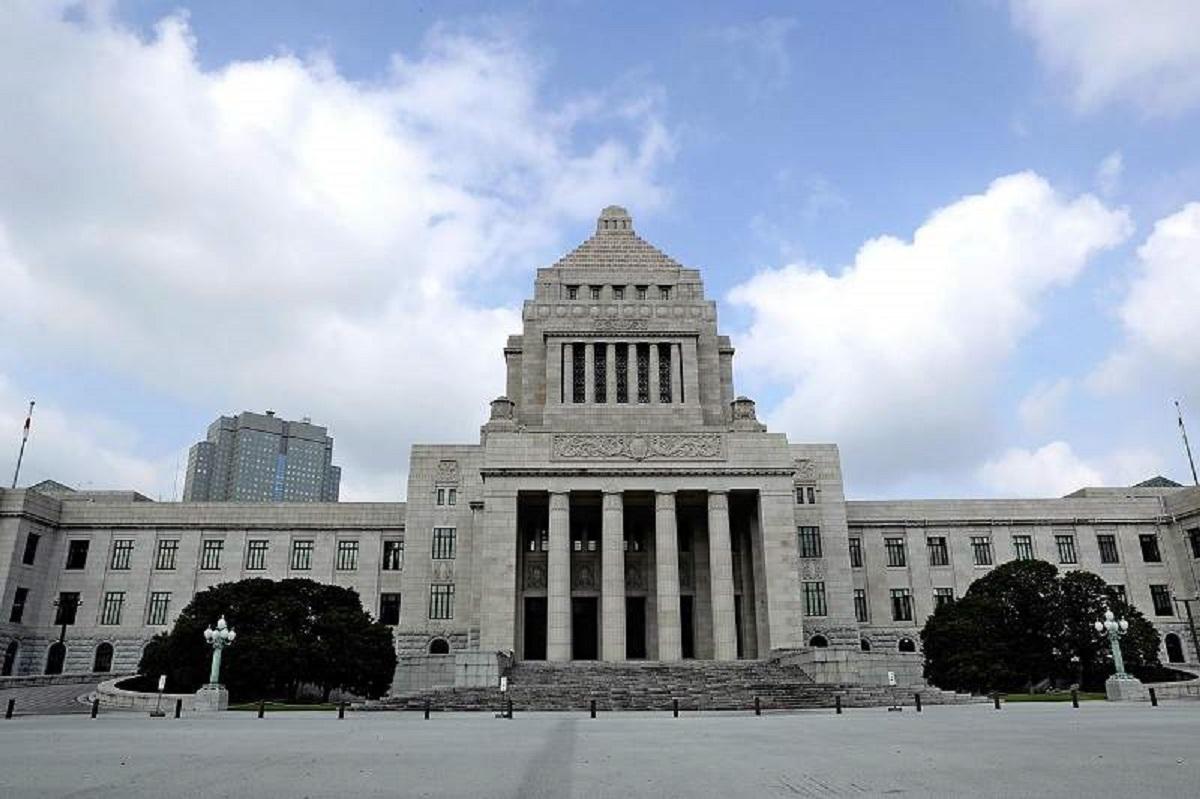
The Diet Building in Chiyoda Ward, Tokyo, Japan.
20:00 JST, August 20, 2025
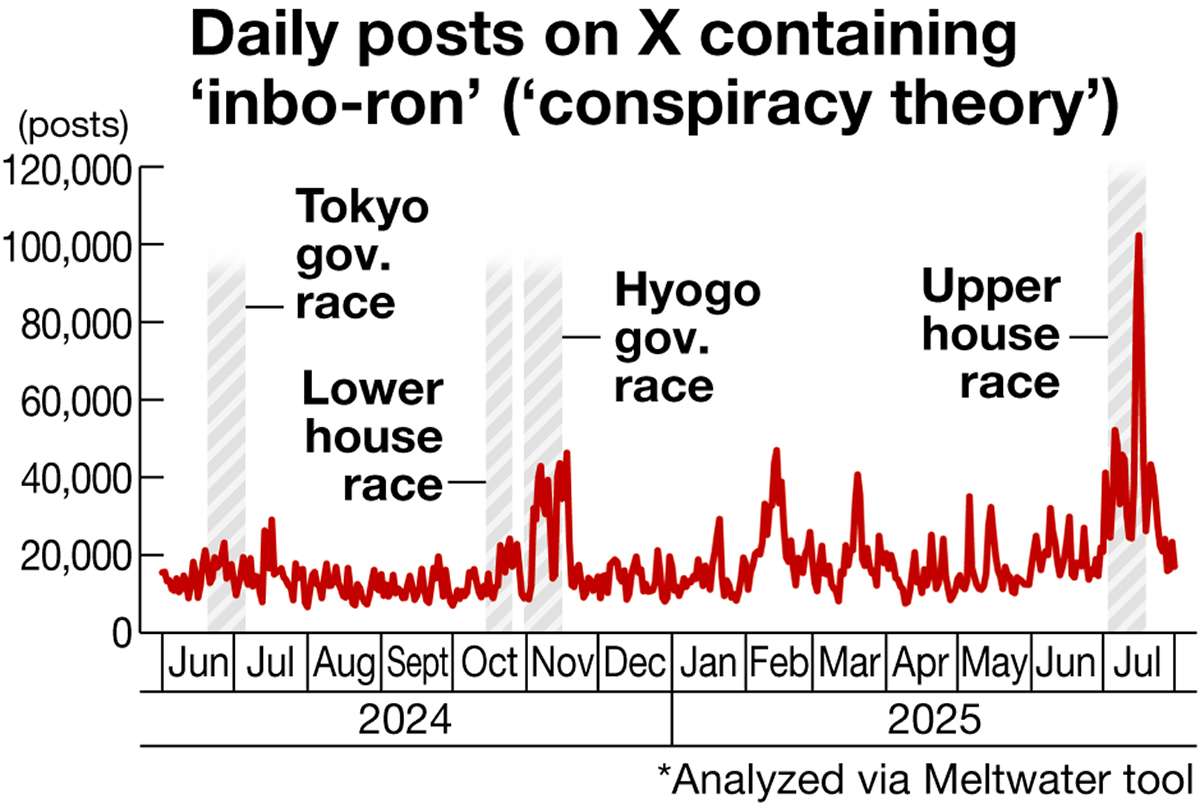
The number of posts containing the Japanese word for “conspiracy theory” averaged 45,000 per day on X during the latest House of Councillors election campaign period, doubling the number posted before the campaign, The Yomiuri Shimbun has found.
The Japanese word “inbo-ron” was frequently used in connection with political party Sanseito’s assertions and allegations of foreign interference in the election. Noting that the spread of unverifiable claims has fueled this trend, an expert warned that an accelerated tit-for-tat conspiracy theory exchange could exacerbate social divisions.
Conspiracy theories are claims that shadowy forces or secret organizations manipulate governments and media to control politics and the economy. On social media, they are often used to dismiss opinions that do not align with one’s own beliefs.
The Yomiuri Shimbun used an analysis tool from U.S.-based firm Meltwater to extract and analyze all posts — including reposts — containing the “conspiracy theory” term from June last year to July this year.
Last year saw the Tokyo gubernatorial election, the House of Representatives election and the Hyogo gubernatorial election, with 15,000 comments containing the term posted on an average day. The number increased to over 20,000 this year and surged to 45,000 during the July upper house election campaign of July 3-19.
During the first half of the July campaign, a series of posts criticized assertions by Sanseito leader Sohei Kamiya as conspiracy theories. These assertions included “Jewish international financial capital controls the world” and “[Multinational corporations] are said to have caused the pandemic.”
Sanseito members fought back against these criticisms with such a post as, “They’re still talking about conspiracy theories,” which went viral. Meanwhile, there were also posts labeling liberal arguments against nuclear power as conspiracy theories.
The period toward the end of the campaign saw an increase in posts against a personal blog that raised suspicions of foreign interference in the election. The blog claimed that Russia was spreading Japanese-language posts criticizing Prime Minister Shigeru Ishiba’s administration that would result in increasing support for Sanseito and other parties.
When both ruling and opposition parties called for an investigation of the allegation, Kamiya posted, “The claim that ‘behind the rise of the Sanseito lies Russian interference’ is precisely the kind of conspiracy theory we’ve been talking about.” This post was shared 14,000 times.
Posts related to U.S. President Donald Trump’s administration have also been prominent this year. A survey found an increase in English-language posts mentioning conspiracy theories overseas.
“Many posts sound the alarm about conspiracy theories, and that itself is a sign that unverified claims are spreading,” Osaka University of Economics Associate Prof. Masaki Hata, who has written books on conspiracy theories, said. “Politicians also tended to exploit unverified claims for their own advantage during elections.”
He said he has the impression that there has been an increase in posts alleging voting fraud, such as those claiming that “votes are being rewritten,” and that could pose a dangerous threat to democracy.


Related Tags


Most Read
Most read in the last 24 hours
-

Tohoku, Hokkaido Tourist Sites Prepare to Evacuate Visitors in Ca...
-

India's Arms Indigenization Quest for Self-Reliance / Desert Dril...
-
26-year-old U.S. National Falls While Climbing Mt. Fuji; Accompan...
-
Japan Passport Fees Going Down to ¥9,000 in July
-

Japanese Side Machida Zelvia Faces Ah-Ahli in Asian Champions Lea...
-

Transfer of Defense Equipment: Increase the Number of Like-minded...
-
Japan Eyes Trialing Dual-Use Tech Developed by Startups to Promot...
-

Charm of Meiji-Era Poet Takuboku Examined from Viewpoint of Donal...
Most read in the last 7 days
-
Earthquake Hits Japan's Tohoku Region; 3-meter Tsunami Warning Is...
-

Trump Extends the Ceasefire with Iran but Keeps the Blockade
-
China, South Korea Object to Japanese PM Takaichi's Ritual Offeri...
-

India's Arms Indigenization Quest for Self-Reliance / New Delhi S...
-
Japan to Ban Use of Portable Chargers on Airplanes from April 24,...
-

¥1,000 Coins to Be Issued to Mark Anniversary of Beginning of Jap...
-

Most Serious Cyberattacks against the UK Now from Russia, Iran an...
-
New Challenges Await as Miura-Kihara Retires; Blade Maker, Ex-Coa...
Most read in the last 30 days
-
Earthquake Hits Japan's Tohoku Region; 3-meter Tsunami Warning Is...
-
Police Find Child's Shoe During Search for Missing Boy in Nantan,...
-
Body Found in Nantan, Kyoto Prefecture, During Search for 11-Year...
-
Cherry Blossoms, Rapeseed Flowers Perform Colorful ‘Duet’ in Niig...
-
Trump Extends the Ceasefire with Iran but Keeps the Blockade
-

Olympic Gold Medal-Winning Figure Skaters Riku-Ryu Announce Retir...
-

Nori Prices Surge in Japan Due to Poor Seaweed Production Amid Ri...
-
China, South Korea Object to Japanese PM Takaichi's Ritual Offeri...
Top Articles in Politics
-
India’s Arms Indigenization Quest for Self-Reliance / New Delhi Sticks to Its ‘All-Alignment’ Guns Even after Iran Warship Attack
-
Japan Aims to Enhance Deterrence, Defense Industry by Allowing Exports of Weapons
-

Former Japan PM Murayama’s Farewell Ceremony Held; Former Deputy PM Kono Vows to ‘Carry on Path Toward Peace’
-

Ritsumeikan Asia Pacific University Stripped of Certification for Simplified Visa Procedures Due to Document Failure
-

Japan’s PM Takaichi Seeks to Advance Policies Bearing Her Own ‘Color,’ Eyes Amending Constitution, Building Strong Economy
JN ACCESS RANKING
-
Earthquake Hits Japan’s Tohoku Region; 3-meter Tsunami Warning Issued (Update 1)
-
Police Find Child’s Shoe During Search for Missing Boy in Nantan, Kyoto Prefecture
-
Body Found in Nantan, Kyoto Prefecture, During Search for 11-Year-Old Boy in Area (Update 1)
-
Cherry Blossoms, Rapeseed Flowers Perform Colorful ‘Duet’ in Niigata
-
Trump Extends the Ceasefire with Iran but Keeps the Blockade
Most read in the last 24 hours
-
Tohoku, Hokkaido Tourist Sites Prepare to Evacuate Visitors in Ca...
-
India's Arms Indigenization Quest for Self-Reliance / Desert Dril...
-
26-year-old U.S. National Falls While Climbing Mt. Fuji; Accompan...
-
Japan Passport Fees Going Down to ¥9,000 in July
-
Japanese Side Machida Zelvia Faces Ah-Ahli in Asian Champions Lea...
Most read in the last 7 days
-
Earthquake Hits Japan's Tohoku Region; 3-meter Tsunami Warning Is...
-
Trump Extends the Ceasefire with Iran but Keeps the Blockade
-
China, South Korea Object to Japanese PM Takaichi's Ritual Offeri...
-
India's Arms Indigenization Quest for Self-Reliance / New Delhi S...
-
Japan to Ban Use of Portable Chargers on Airplanes from April 24,...
Most read in the last 30 days
-
Earthquake Hits Japan's Tohoku Region; 3-meter Tsunami Warning Is...
-
Police Find Child's Shoe During Search for Missing Boy in Nantan,...
-
Body Found in Nantan, Kyoto Prefecture, During Search for 11-Year...
-
Cherry Blossoms, Rapeseed Flowers Perform Colorful ‘Duet’ in Niig...
-
Trump Extends the Ceasefire with Iran but Keeps the Blockade