
President Nawrocki Refuses to Sign Law to Tap 44b Euros in EU Defense Loans for Poland
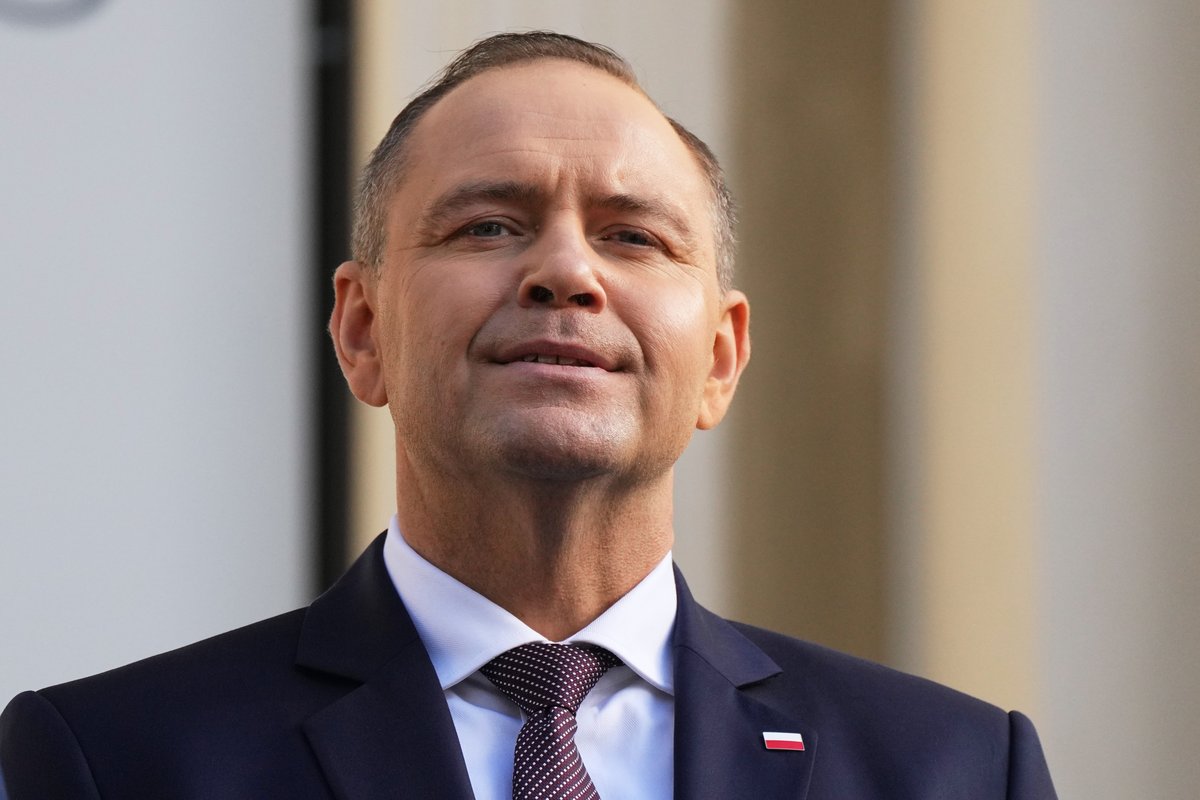
President of Poland Karol Nawrocki attends a group photo during the 20-th informal meeting of the Arraiolos Group Heads of State in Tallinn, Estonia, Friday, Oct. 10, 2025.
11:13 JST, March 11, 2026
WARSAW, Poland (AP) — Polish President Karol Nawrocki refused Tuesday to sign a law enabling Poland to access almost 44 billion euros in preferential defense loans facilitated by the European Union, claiming it would be wrong to make Poland more dependent on Brussels.
Instead, the president proposed an alternative draft law suggesting national resources that could be used instead of European loans to pay for further investments in defense.
Subsequent Polish governments have boosted Poland’s defense spending since Russia’s full-scale invasion of neighboring Ukraine in 2022. But while the liberal government led by Donald Tusk is happy to coordinate efforts with the European Union, the nationalist president has proven more euro-skeptic and maintained a friendlier rapport with the Trump administration.
Since taking office last year, Nawrocki has positioned himself as a main opponent of the influential prime minister, repeatedly vetoing laws proposed by the executive.
According to Nawrocki’s office, the president still has until March 20 to decide on whether he will ultimately veto the government’s law on the EU defense loan.
Poland was set to be the largest beneficiary of the 150 billion-euro EU loan program dubbed SAFE, or Security Action for Europe, and meant to boost European defense readiness in a period when the U.S. has been diminishing its role in the continent’s security.
To access the funds, the liberal Polish government prepared a list of 139 projects it intends to finance with the money, 30 of which are dedicated to strengthening the country’s eastern borders. It promised 80% of the money will go to domestic industry.
Yet Nawrocki and the main opposition party supporting him, the national-conservative Law and Justice, or PiS, have been critical of Poland’s participation in SAFE. They argue the money comes with EU conditions, making Poland more dependent on Germany, and encourages purchases from European manufacturers at the expense of U.S. producers.
“Polish independence has no price,” PiS leader Jarosław Kaczyński said last month. “What they propose to us is a Poland under the German boot, and we are rejecting this German boot.”
The U.S. has also openly criticized SAFE.
“The United States has expressed concerns about how EU defense initiatives like Security Action for Europe (SAFE) and the European Defense Industry Program (EDIP) restrict market access for American companies,” Andrew Puzder, the U.S. ambassador to the EU, and Matthew Whitaker, the U.S. ambassador to NATO, wrote in an opinion piece published in February by POLITICO Europe.
The two wrote that such European programs “undermine collective defense” by limiting competition, stifling innovation and depriving U.S. companies of necessary orders.
“I can’t understand how, in a situation with global conflicts and war on our border, someone can think about blocking such things as SAFE, those billions for the Polish army and arms industry,” Tusk said, commenting on Nawrocki’s resistance to SAFE. “But no matter how striking that is, we will surely prepare a plan B.”
The Polish government had earlier said it would be able to still take advantage of SAFE in case of a veto by Nawrocki, albeit under more restrictive conditions.







Most Read
Most read in the last 24 hours
-

Govt May Revise Law to Allow Export of Defense Equipment for Free
-

Undrafted Japanese Kicker Signs with Raiders; ‘My Appeal Is My Ac...
-

Number of Immigration Officer-Escorted Forced Deportations in Jap...
-
Spring Bear Hunting Gets Fully Underway As Prefectures Deal With ...
-

Dutch Man Injured on Closed Mt. Fuji Route, Having Fallen While D...
-

Princess Aiko Enjoys Imperial Court Music, Dance; Production, Cos...
-

Mother Supports My Sister Too Much, Gives Her Kids Much More Than...
-

Sabastian Sawe of Kenya Becomes First Person to Run a Sub-2-hour ...
Most read in the last 7 days
-
Earthquake Hits Japan's Tohoku Region; 3-meter Tsunami Warning Is...
-
China, South Korea Object to Japanese PM Takaichi's Ritual Offeri...
-

Trump Extends the Ceasefire with Iran but Keeps the Blockade
-

India's Arms Indigenization Quest for Self-Reliance / New Delhi S...
-

¥1,000 Coins to Be Issued to Mark Anniversary of Beginning of Jap...
-

Most Serious Cyberattacks against the UK Now from Russia, Iran an...
-

Trump Opposes United–American Merger, Signals Support for Spirit
-

System Malfunction in Haneda Airport Causes 83 Flight Cancelation...
Most read in the last 30 days
-
Earthquake Hits Japan's Tohoku Region; 3-meter Tsunami Warning Is...
-
Police Find Child's Shoe During Search for Missing Boy in Nantan,...
-
Body Found in Nantan, Kyoto Prefecture, During Search for 11-Year...
-
China, South Korea Object to Japanese PM Takaichi's Ritual Offeri...
-

Cherry Blossoms, Rapeseed Flowers Perform Colorful ‘Duet’ in Niig...
-
Trump Extends the Ceasefire with Iran but Keeps the Blockade
-

Olympic Gold Medal-Winning Figure Skaters Riku-Ryu Announce Retir...
-
Japanese Prime Minister Takaichi Speaks to Pakistani Prime Minist...
Top Articles in News Services
-
Trump Extends the Ceasefire with Iran but Keeps the Blockade
-
Most Serious Cyberattacks against the UK Now from Russia, Iran and China, Cyber Chief Says
-
Trump Opposes United–American Merger, Signals Support for Spirit
-

Florida Launches Criminal Probe into OpenAI and ChatGPT over Deadly Shooting
-

Trump Picks a University of Minnesota Professor to Lead His Economic Council
JN ACCESS RANKING
-
Earthquake Hits Japan’s Tohoku Region; 3-meter Tsunami Warning Issued (Update 1)
-
Police Find Child’s Shoe During Search for Missing Boy in Nantan, Kyoto Prefecture
-
Body Found in Nantan, Kyoto Prefecture, During Search for 11-Year-Old Boy in Area (Update 1)
-
China, South Korea Object to Japanese PM Takaichi’s Ritual Offering to Yasukuni Shrine
-
Cherry Blossoms, Rapeseed Flowers Perform Colorful ‘Duet’ in Niigata
Most read in the last 24 hours
-
Govt May Revise Law to Allow Export of Defense Equipment for Free
-
Undrafted Japanese Kicker Signs with Raiders; ‘My Appeal Is My Ac...
-
Number of Immigration Officer-Escorted Forced Deportations in Jap...
-
Spring Bear Hunting Gets Fully Underway As Prefectures Deal With ...
-
Dutch Man Injured on Closed Mt. Fuji Route, Having Fallen While D...
Most read in the last 7 days
-
Earthquake Hits Japan's Tohoku Region; 3-meter Tsunami Warning Is...
-
China, South Korea Object to Japanese PM Takaichi's Ritual Offeri...
-
Trump Extends the Ceasefire with Iran but Keeps the Blockade
-
India's Arms Indigenization Quest for Self-Reliance / New Delhi S...
-
¥1,000 Coins to Be Issued to Mark Anniversary of Beginning of Jap...
Most read in the last 30 days
-
Earthquake Hits Japan's Tohoku Region; 3-meter Tsunami Warning Is...
-
Police Find Child's Shoe During Search for Missing Boy in Nantan,...
-
Body Found in Nantan, Kyoto Prefecture, During Search for 11-Year...
-
China, South Korea Object to Japanese PM Takaichi's Ritual Offeri...
-
Cherry Blossoms, Rapeseed Flowers Perform Colorful ‘Duet’ in Niig...