
12 Years After Great East Japan Earthquake / Eastern Japan Weighs Response in Case of Another Disaster
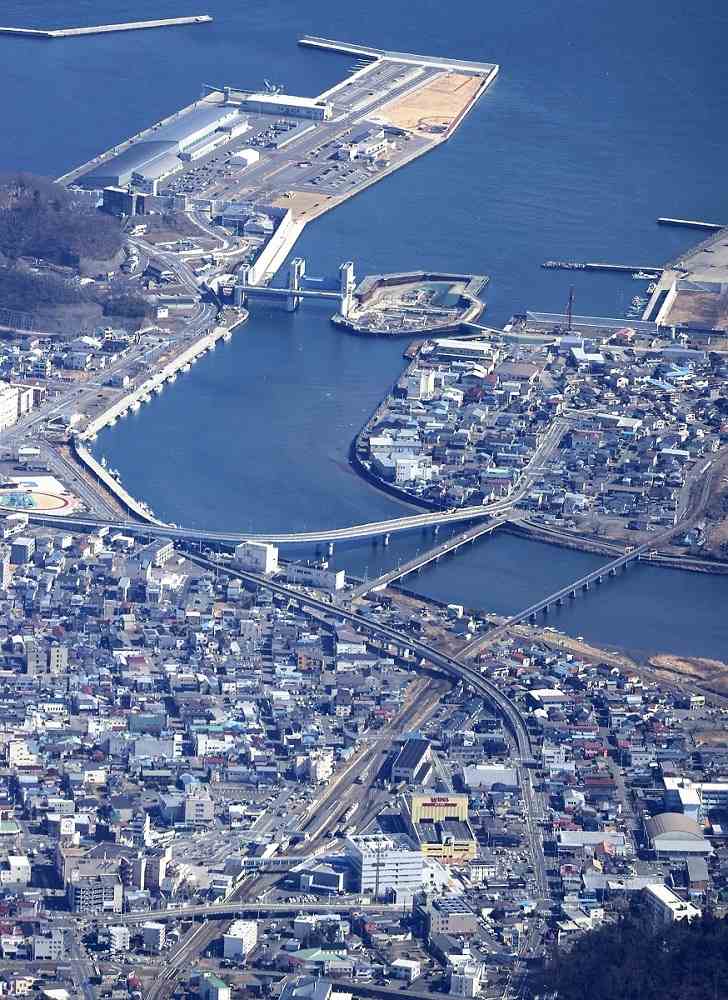
The new municipal building in Miyako, Iwate Prefecture, which is expected to be inundated following a major earthquake, is seen from the air on Feb. 27.
2:00 JST, March 11, 2023
Saturday marks 12 years since the 2011 Great East Japan Earthquake. While continuing to grapple with post-quake reconstruction issues, affected communities are giving serious thought to how best to prepare for another calamity. This is the first installment of a series in which we take a close look at the main issues to be addressed.
***
Devastating potential
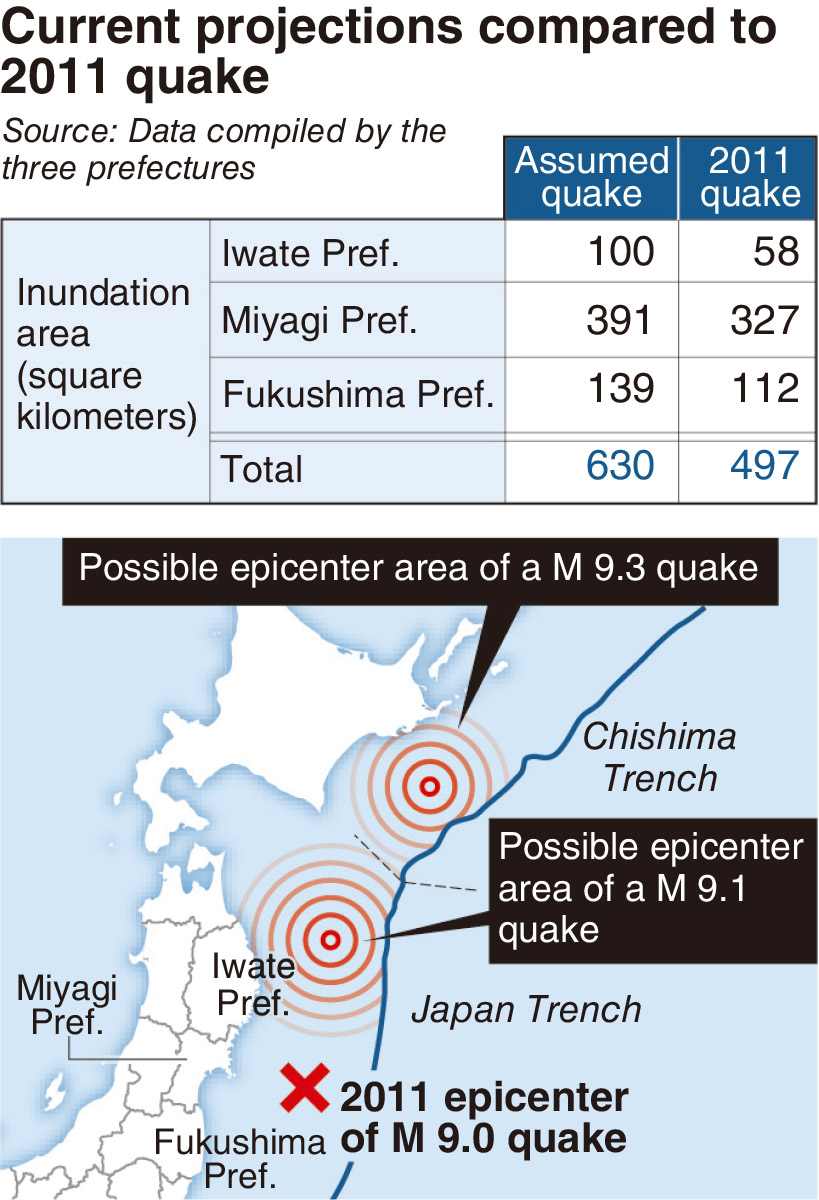
Following a 2020 government announcement regarding an anticipated earthquake that could be even more devastating than the 2011 quake, coastal municipalities in Iwate, Miyagi, and Fukushima prefectures, which were heavily damaged by the temblor and tsunami, have been weighting their respective responses to another catastrophe.
The three prefectures last year estimated a 30% expansion in the area that would be inundated, based on the government’s prediction of a “largest-scale tsunami.”
A survey conducted by the Yomiuri Shimbun in January found that 42 facilities, or 40% of the key disaster-response facilities in 37 coastal municipalities — including main government offices and fire stations — are at risk of inundation.
Municipalities that have taken countermeasures based on lessons learned from the 2011 disaster voiced exasperation regarding these results, questioning the meaning of their efforts over the past dozen years.
In April 2020, the government released a map of areas likely to be inundated by a tsunami following a magnitude 9 earthquake with an epicenter in or around the Japan Trench and Chishima Trench off the coast of the Tohoku region and Hokkaido. In December 2021, Tokyo also posited that in a worst-case scenario — such as a massive earthquake occurring late at night during wintertime — up to 199,000 people could die, eclipsing the number of people who perished in the 2011 quake.
In response, during the period from March to December last year, the three prefectures released their own inundation and damage estimates. According to these estimates, the maximum expected tsunami height is 29.5 meters in Miyako, Iwate Prefecture. The total area predicted to be inundated in the three prefectures has been expanded to 630 square kilometers — or an area 30% larger than 2011 — with the anticipated death toll rising to as high as 14,249.
Regarding areas anticipated to be inundated, the Yomiuri Shimbun surveyed 37 coastal municipalities of cities, towns, and villages in the three prefectures in January, and found that 18 main municipal office buildings (or 49% of all such buildings), 15 fire stations (or 38%), and 9 police stations (or 38%), were located within the anticipated areas. When branch offices of the municipal governments and police boxes are included, the total number of such disaster-response bases that could be flooded is 120.
If key disaster-response facilities were to be flooded, tasks such as guiding people to shelters and carrying out lifesaving activities could be hindered.
In the 2011 quake, municipal government offices in Rikuzentakata City and Otsuchi Town in Iwate Prefecture, and those of Minami-Sanriku and Onagawa towns in Miyagi Prefecture were destroyed by flooding. Six of the 18 main municipal government offices thought to be at risk of possible inundation were relocated following the 2011 earthquake.
The municipal government office in Miyako, which was submerged up to the second floor in 2011, was relocated further inland in 2018. However, the latest hypothesis suggests the city could see up to 18.7 square kilometers of flooding, nearly twice the area affected previously. Concerned that the new government building could be hit by potential flooding of up to 2.92 meters, the city decided to install pumps to supply fuel to the emergency power generators on the second floor and higher.
“We’ll work to the bitter end to respond [appropriately] by assuming a worst-case scenario, but what should we do about our town building?” Miyako Mayor Masanori Yamamoto said.
Meanwhile, the city government of Kamaishi, Iwate Prefecture, has modified the floor plan for its new planned government building. Worried that the building could be flooded by between 3 meters and 5 meters of water, it has relocated the planned administrative offices to the second floor and above.
Kamaishi Mayor Takenori Noda lamented, “With these latest estimates, it feels like our post-quake reconstruction goals have become even more distant.”


Related Tags



Most Read
Most read in the last 24 hours
-

India's Arms Indigenization Quest for Self-Reliance / Desert Dril...
-
26-year-old U.S. National Falls While Climbing Mt. Fuji; Accompan...
-
Japan Passport Fees Going Down to ¥9,000 in July
-

Japanese Side Machida Zelvia Faces Ah-Ahli in Asian Champions Lea...
-

Transfer of Defense Equipment: Increase the Number of Like-minded...
-

Japan Eyes Trialing Dual-Use Tech Developed by Startups to Promot...
-

Charm of Meiji-Era Poet Takuboku Examined from Viewpoint of Donal...
-
Cherry Blossoms in Full Bloom in Hokkaido's Hakodate; Tourists Fl...
Most read in the last 7 days
-
Earthquake Hits Japan's Tohoku Region; 3-meter Tsunami Warning Is...
-

Trump Extends the Ceasefire with Iran but Keeps the Blockade
-

China, South Korea Object to Japanese PM Takaichi's Ritual Offeri...
-

India's Arms Indigenization Quest for Self-Reliance / New Delhi S...
-

Japan to Ban Use of Portable Chargers on Airplanes from April 24,...
-

¥1,000 Coins to Be Issued to Mark Anniversary of Beginning of Jap...
-

Most Serious Cyberattacks against the UK Now from Russia, Iran an...
-
New Challenges Await as Miura-Kihara Retires; Blade Maker, Ex-Coa...
Most read in the last 30 days
-
Earthquake Hits Japan's Tohoku Region; 3-meter Tsunami Warning Is...
-
Police Find Child's Shoe During Search for Missing Boy in Nantan,...
-
Body Found in Nantan, Kyoto Prefecture, During Search for 11-Year...
-
Cherry Blossoms, Rapeseed Flowers Perform Colorful ‘Duet’ in Niig...
-
Trump Extends the Ceasefire with Iran but Keeps the Blockade
-

Olympic Gold Medal-Winning Figure Skaters Riku-Ryu Announce Retir...
-

Nori Prices Surge in Japan Due to Poor Seaweed Production Amid Ri...
-
China, South Korea Object to Japanese PM Takaichi's Ritual Offeri...
Top Articles in Society
-
Earthquake Hits Japan’s Tohoku Region; 3-meter Tsunami Warning Issued (Update 1)
-
Police Find Child’s Shoe During Search for Missing Boy in Nantan, Kyoto Prefecture
-
Body Found in Nantan, Kyoto Prefecture, During Search for 11-Year-Old Boy in Area (Update 1)
-
Cherry Blossoms, Rapeseed Flowers Perform Colorful ‘Duet’ in Niigata
-
Two Women in Osaka Found Lying on Floor Bleeding, Later Pronounced Dead
JN ACCESS RANKING
-
Earthquake Hits Japan’s Tohoku Region; 3-meter Tsunami Warning Issued (Update 1)
-
Police Find Child’s Shoe During Search for Missing Boy in Nantan, Kyoto Prefecture
-
Body Found in Nantan, Kyoto Prefecture, During Search for 11-Year-Old Boy in Area (Update 1)
-
Cherry Blossoms, Rapeseed Flowers Perform Colorful ‘Duet’ in Niigata
-
Trump Extends the Ceasefire with Iran but Keeps the Blockade
Most read in the last 24 hours
-
India's Arms Indigenization Quest for Self-Reliance / Desert Dril...
-
26-year-old U.S. National Falls While Climbing Mt. Fuji; Accompan...
-
Japan Passport Fees Going Down to ¥9,000 in July
-
Japanese Side Machida Zelvia Faces Ah-Ahli in Asian Champions Lea...
-
Transfer of Defense Equipment: Increase the Number of Like-minded...
Most read in the last 7 days
-
Earthquake Hits Japan's Tohoku Region; 3-meter Tsunami Warning Is...
-
Trump Extends the Ceasefire with Iran but Keeps the Blockade
-
China, South Korea Object to Japanese PM Takaichi's Ritual Offeri...
-
India's Arms Indigenization Quest for Self-Reliance / New Delhi S...
-
Japan to Ban Use of Portable Chargers on Airplanes from April 24,...
Most read in the last 30 days
-
Earthquake Hits Japan's Tohoku Region; 3-meter Tsunami Warning Is...
-
Police Find Child's Shoe During Search for Missing Boy in Nantan,...
-
Body Found in Nantan, Kyoto Prefecture, During Search for 11-Year...
-
Cherry Blossoms, Rapeseed Flowers Perform Colorful ‘Duet’ in Niig...
-
Trump Extends the Ceasefire with Iran but Keeps the Blockade