
Company Cafeterias in Tokyo Support Employees’ Household Budgets as Tax Reforms Provide Tailwind
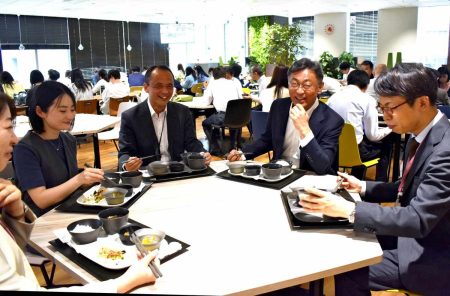
Tokyo Star Bank President Takeshi Ito, second from right, eats lunch with bank employees in the employee cafeteria at the bank’s head office in Tokyo on Wednesday.
20:00 JST, April 23, 2026
As the cost of eating out soars due to rising prices, companies in Tokyo are increasingly introducing employee cafeterias where staff can eat at affordable prices.
With the new fiscal year’s tax reforms significantly raising the tax-exempt limit for meal subsidies provided by companies, there is a growing trend of supporting employees’ household budgets.
At the head office of Tokyo Star Bank in the Akasaka district in Minato Ward, Tokyo, the employee cafeteria was bustling at lunchtime on Wednesday. Four menu items were available, including a daily special for ¥530 and fried eggplant with Chinese chili sauce on rice.
In March last year, as part of its efforts to create an attractive office environment, the bank introduced a “kitchenless cafeteria” with no kitchen or drainage facilities. Lunches prepared at a production facility are delivered and served hot.
Kazuhisa Miyoshi, a 43-year-old employee, said with a smile, “Eating out can sometimes cost around ¥1,500, so the cafeteria is a huge help for my household budget.”
A bank spokesperson noted, “We can offer meals for around ¥500, which helps support our employees financially.”
According to a March survey by Recruit Co. of workers in the Tokyo metropolitan area and Tokai and Kansai regions, the average budget for weekday lunches for eating out rose to a record high of ¥1,338, up ¥88 from the previous year.
Amid soaring lunch costs, employee cafeterias — where companies subsidize employees’ food expenses — are drawing attention as a source of affordable meals.
According to Bondish, based in Chiyoda Ward, Tokyo, which operates the bank’s cafeteria, a growing number of companies are adopting kitchenless cafeterias, with inquiries from January to March rising 40% on a year-on-year basis.
Higher tax-exempt limit
The tax reforms for this fiscal year are encouraging corporate meal subsidies.
While there was already a system in place in which income tax is not levied on meal expenses subsidized by companies during work hours up to a certain amount, the government has raised this tax-exempt limit for the first time in 42 years to address rising prices. The limit has been increased from ¥3,500 to ¥7,500 per person per month.
As long as employees pay at least half of the total cost, they will pay no income tax on their meal subsidy.
For example, if an employee spent a total of ¥15,000 on meals in a month, the ¥7,500 subsidized by the company will be tax-exempt as long as the employee covers half of the total cost. However, if the employee’s contribution falls short of half of the total, the entire company subsidy will be subject to income tax.
Since meal subsidies effectively increase employees’ take-home pay, they are garnering attention as the “third form of wage increase.”
Related services grow
Following the tax reforms, companies offering corporate meal services have been receiving a flood of inquiries.
Ezaki Glico Co., based in Osaka City, which allows companies to offer corporate meals without setting up a cafeteria, expanded its delivery-based corporate meal service “Sunao Delivery” to the Tokyo metropolitan area in April. It was previously only available in Osaka City.
The service can be used for as few as five meals per day, and the company said it has received many inquiries from small and midsize enterprises.
Edenred Japan Co., based in Minato Ward, Tokyo, offers “Ticket Restaurant,” a meal subsidy service that uses a dedicated smart card for payment.
Employees and their companies split the amount of money deposited on the card, which can be used to purchase meals at participating convenience stores and restaurants.
The company said that inquiries have increased significantly compared to last year.







Most Read
Most read in the last 24 hours
-

India's Arms Indigenization Quest for Self-Reliance / New Delhi S...
-
Bonds between Iran, Kikaijima Shine as Concerns Rise over Iranian...
-

Most Serious Cyberattacks against the UK Now from Russia, Iran an...
-

Iran Fires on 3 Ships in the Strait of Hormuz as US Maintains Blo...
-

Trump Envoy Seeks to Replace Iran with Italy in Upcoming World Cu...
-

EU Close to Approving a $106B Loan for Ukraine after Months of De...
-

White Sox Rookie Munetaka Murakami Ties MLB Rookie Record with HR...
-

Airline Company Lufthansa Cuts 20,000 Flights as War Squeezes Fue...
Most read in the last 7 days
-
Earthquake Hits Japan's Tohoku Region; 3-meter Tsunami Warning Is...
-

Trump Extends the Ceasefire with Iran but Keeps the Blockade
-

Olympic Gold Medal-Winning Figure Skaters Riku-Ryu Announce Retir...
-
China, South Korea Object to Japanese PM Takaichi's Ritual Offeri...
-
Japan to Ban Use of Portable Chargers on Airplanes from April 24,...
-
¥1,000 Coins to Be Issued to Mark Anniversary of Beginning of Jap...
-
New Challenges Await as Miura-Kihara Retires; Blade Maker, Ex-Coa...
-
Trump Opposes United–American Merger, Signals Support for Spirit
Most read in the last 30 days
-
Earthquake Hits Japan's Tohoku Region; 3-meter Tsunami Warning Is...
-

Police Find Child's Shoe During Search for Missing Boy in Nantan,...
-

Body Found in Nantan, Kyoto Prefecture, During Search for 11-Year...
-

Cherry Blossoms, Rapeseed Flowers Perform Colorful ‘Duet’ in Niig...
-
Trump Extends the Ceasefire with Iran but Keeps the Blockade
-
Olympic Gold Medal-Winning Figure Skaters Riku-Ryu Announce Retir...
-
Nori Prices Surge in Japan Due to Poor Seaweed Production Amid Ri...
-
Japanese Prime Minister Takaichi Speaks to Pakistani Prime Minist...
Top Articles in Business
-
Foreign Tourists Set New Record in March; 30% Drop in Visitors from Middle East
-
Japan’s ANA to Introduce Fuel Surcharges to Domestic Flights from Fy27, Driven by Rising Fuel Costs, Declining Profits
-
Middle Powers Should Create Alternative to WTO, Says Research Group
-
Airborne Cellular Stations to Be Tested in Ishikawa, Miyagi; Aim to Ensure Communication During Disasters
-
Toyota Motor to Begin Full-Scale Hydrogen Production in May; Mass Production and Sales of Equipment Planned to Start in 2029
JN ACCESS RANKING
-
Earthquake Hits Japan’s Tohoku Region; 3-meter Tsunami Warning Issued (Update 1)
-
Police Find Child’s Shoe During Search for Missing Boy in Nantan, Kyoto Prefecture
-
Body Found in Nantan, Kyoto Prefecture, During Search for 11-Year-Old Boy in Area (Update 1)
-
Cherry Blossoms, Rapeseed Flowers Perform Colorful ‘Duet’ in Niigata
-
Trump Extends the Ceasefire with Iran but Keeps the Blockade
Most read in the last 24 hours
-
India's Arms Indigenization Quest for Self-Reliance / New Delhi S...
-
Bonds between Iran, Kikaijima Shine as Concerns Rise over Iranian...
-
Most Serious Cyberattacks against the UK Now from Russia, Iran an...
-
Iran Fires on 3 Ships in the Strait of Hormuz as US Maintains Blo...
-
Trump Envoy Seeks to Replace Iran with Italy in Upcoming World Cu...
Most read in the last 7 days
-
Earthquake Hits Japan's Tohoku Region; 3-meter Tsunami Warning Is...
-
Trump Extends the Ceasefire with Iran but Keeps the Blockade
-
Olympic Gold Medal-Winning Figure Skaters Riku-Ryu Announce Retir...
-
China, South Korea Object to Japanese PM Takaichi's Ritual Offeri...
-
Japan to Ban Use of Portable Chargers on Airplanes from April 24,...
Most read in the last 30 days
-
Earthquake Hits Japan's Tohoku Region; 3-meter Tsunami Warning Is...
-
Police Find Child's Shoe During Search for Missing Boy in Nantan,...
-
Body Found in Nantan, Kyoto Prefecture, During Search for 11-Year...
-
Cherry Blossoms, Rapeseed Flowers Perform Colorful ‘Duet’ in Niig...
-
Trump Extends the Ceasefire with Iran but Keeps the Blockade