
6 Months Since Japan’s Prime Minister Sanae Takaichi Came to Power, She Faces Challenges to Achieve Her Flagship Policies
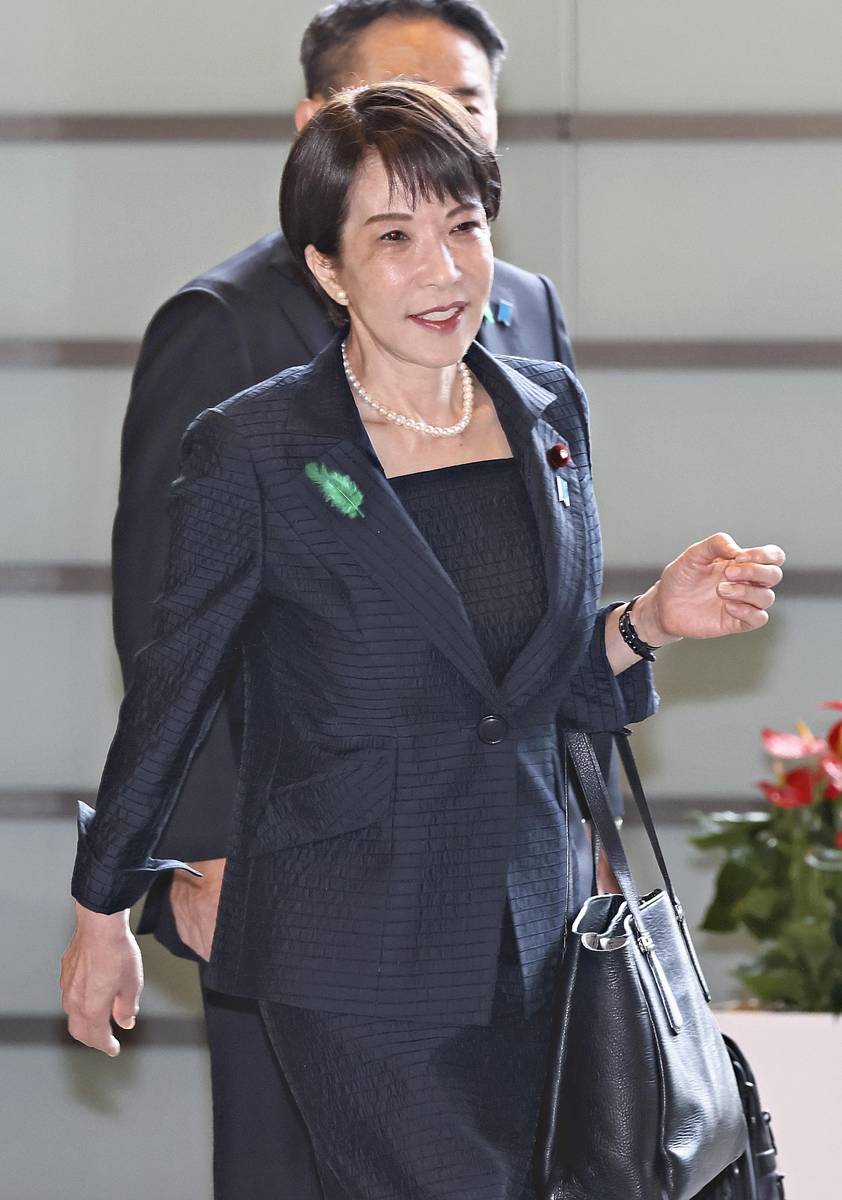
Prime Minister Sanae Takaichi enters the Prime Minister’s Office on Monday.
17:37 JST, April 21, 2026
With Tuesday marking half a year since Prime Minister Sanae Takaichi came to power, she has been working to solidify her administration’s foundation by advocating policies such as “responsible and proactive public finances.”
However, the full implementation of her flagship policies — including the strengthening of intelligence gathering and analysis — is yet to come. In addition, her ability to govern will be put to the test as the ruling coalition is in the minority in the House of Councillors.
While receiving a report on the government’s growth strategy from Minoru Kiuchi, the minister in charge of Japan’s growth strategy, and other officials at the Prime Minister’s Office on Monday, Takaichi issued an instruction as she reviewed the briefing materials. “We should shorten this part a bit,” she said.
Since taking office, Takaichi has championed “responsible and proactive public finances” and advocated for a shift toward policies prioritizing economic growth.
In November last year, Takaichi established the Headquarters for Japan’s Growth Strategy with herself as head, and she has been working with vice head Kiuchi to flesh out the strategy.
The Prime Minister’s Office has taken the lead in addressing issues such as dealing with foreign nationals and measures to secure crude oil and petroleum products amid escalating tensions in the Middle East.
The supplementary budget for the previous fiscal year, which totaled ¥18.3 trillion in the general account and was approved in December last year, was part of these efforts.
With the budget for the current fiscal year — inherited from the previous administration — approved on April 7, the challenge going forward will be finding ways to implement her flagship policies that, in her words, are for “policies that would divide public opinion.”
Resistance from opposition
The first initiative was a bill to establish a national intelligence council to strengthen intelligence capabilities, and deliberations in the House of Representatives are nearing their conclusion.
Opposition parties oppose separate, planned anti-espionage legislation, arguing that it will “intensify government surveillance of the public.” Some opposition parties are expressing concern that “the two pieces of legislation are inseparable.”
Similarly, the opposition is against a planned reduction in the number of lower house seats, a policy that is included in the agreement between the two parties that comprise the ruling coalition.
In regard to the implementation of a consumption tax cut on food items — which Takaichi considers her “long-cherished goal” — discussions are underway within the national council on social security established in February by the government and both the ruling and opposition parties, but reaching a consensus is proving difficult.
The ruling coalition remains in the minority in the upper house. However, since the Liberal Democratic Party achieved a landslide victory in the February lower house election, securing more than two-thirds of the total seats, it has become possible to pass bills even if they are rejected in the upper house by passing them again in the lower house.
Hard-line arguments for such a move are being made as a senior ruling party lawmaker said, “We have the backing of the most recent public sentiment [via the election], so passing bills again [in the lower house] will not provoke public backlash.”
During deliberations on the budget for the 2026 fiscal year, the ruling parties powered through management of the Diet by repeatedly invoking the committee chairperson’s authority in the lower house, drawing fierce opposition from the opposition parties.
Similarly, if the ruling parties play the “re-passage” card, they risk facing criticism from the opposition for “disregarding the upper house,” which could hinder deliberations on future bills, forcing the ruling parties to exercise restraint.
Within the LDP, there is also a persistent view: “It is unavoidable to show a certain degree of consideration for the opposition, including regarding the content of bills,” said a veteran lawmaker.
Proactive diplomacy
The government also faces challenges on the diplomatic front. Takaichi had two Japan-U.S. summits with U.S. President Donald Trump that went off without a hitch — one in October and another in March.
On the other hand, relations with China have cooled following her Diet remarks regarding a potential Taiwan contingency, and the situation continues with no sign of improvement in sight.
Under such circumstances, in response to the ongoing tensions in the Middle East, Takaichi is actively conducting telephone talks with leaders of Middle Eastern and Asian nations in an effort to enhance Japan’s presence.
Takaichi also intends to link these efforts to the promotion of the revised “free and open Indo-Pacific” vision that is set to become her new diplomatic policy.
Although Takaichi was notably reliant on the diplomatic legacy of former Prime Minister Shinzo Abe — whom she holds up as a political model — immediately after taking office, she has now demonstrated her willingness to take an active diplomatic stance through means such as the announcement of the new vision.
“[Takaichi] seems to hope to show that she can stand on her own in foreign policy as well,” said a source close to her.








Most Read
Most read in the last 24 hours
-

India's Arms Indigenization Quest for Self-Reliance / New Delhi S...
-

Bonds between Iran, Kikaijima Shine as Concerns Rise over Iranian...
-

Most Serious Cyberattacks against the UK Now from Russia, Iran an...
-

Iran Fires on 3 Ships in the Strait of Hormuz as US Maintains Blo...
-

Trump Envoy Seeks to Replace Iran with Italy in Upcoming World Cu...
-

EU Close to Approving a $106B Loan for Ukraine after Months of De...
-

White Sox Rookie Munetaka Murakami Ties MLB Rookie Record with HR...
-

Airline Company Lufthansa Cuts 20,000 Flights as War Squeezes Fue...
Most read in the last 7 days
-
Earthquake Hits Japan's Tohoku Region; 3-meter Tsunami Warning Is...
-

Trump Extends the Ceasefire with Iran but Keeps the Blockade
-

Olympic Gold Medal-Winning Figure Skaters Riku-Ryu Announce Retir...
-
China, South Korea Object to Japanese PM Takaichi's Ritual Offeri...
-

Japan to Ban Use of Portable Chargers on Airplanes from April 24,...
-

¥1,000 Coins to Be Issued to Mark Anniversary of Beginning of Jap...
-

New Challenges Await as Miura-Kihara Retires; Blade Maker, Ex-Coa...
-

Trump Opposes United–American Merger, Signals Support for Spirit
Most read in the last 30 days
-
Earthquake Hits Japan's Tohoku Region; 3-meter Tsunami Warning Is...
-
Police Find Child's Shoe During Search for Missing Boy in Nantan,...
-

Body Found in Nantan, Kyoto Prefecture, During Search for 11-Year...
-

Cherry Blossoms, Rapeseed Flowers Perform Colorful ‘Duet’ in Niig...
-
Trump Extends the Ceasefire with Iran but Keeps the Blockade
-
Olympic Gold Medal-Winning Figure Skaters Riku-Ryu Announce Retir...
-

Nori Prices Surge in Japan Due to Poor Seaweed Production Amid Ri...
-
Japanese Prime Minister Takaichi Speaks to Pakistani Prime Minist...
Top Articles in Politics
-
India’s Arms Indigenization Quest for Self-Reliance / New Delhi Sticks to Its ‘All-Alignment’ Guns Even after Iran Warship Attack
-

Japan Aims to Enhance Deterrence, Defense Industry by Allowing Exports of Weapons
-

Former Japan PM Murayama’s Farewell Ceremony Held; Former Deputy PM Kono Vows to ‘Carry on Path Toward Peace’
-

Ritsumeikan Asia Pacific University Stripped of Certification for Simplified Visa Procedures Due to Document Failure
-

Japan’s PM Takaichi Seeks to Advance Policies Bearing Her Own ‘Color,’ Eyes Amending Constitution, Building Strong Economy
JN ACCESS RANKING
-
Earthquake Hits Japan’s Tohoku Region; 3-meter Tsunami Warning Issued (Update 1)
-
Police Find Child’s Shoe During Search for Missing Boy in Nantan, Kyoto Prefecture
-
Body Found in Nantan, Kyoto Prefecture, During Search for 11-Year-Old Boy in Area (Update 1)
-
Cherry Blossoms, Rapeseed Flowers Perform Colorful ‘Duet’ in Niigata
-
Trump Extends the Ceasefire with Iran but Keeps the Blockade
Most read in the last 24 hours
-
India's Arms Indigenization Quest for Self-Reliance / New Delhi S...
-
Bonds between Iran, Kikaijima Shine as Concerns Rise over Iranian...
-
Most Serious Cyberattacks against the UK Now from Russia, Iran an...
-
Iran Fires on 3 Ships in the Strait of Hormuz as US Maintains Blo...
-
Trump Envoy Seeks to Replace Iran with Italy in Upcoming World Cu...
Most read in the last 7 days
-
Earthquake Hits Japan's Tohoku Region; 3-meter Tsunami Warning Is...
-
Trump Extends the Ceasefire with Iran but Keeps the Blockade
-
Olympic Gold Medal-Winning Figure Skaters Riku-Ryu Announce Retir...
-
China, South Korea Object to Japanese PM Takaichi's Ritual Offeri...
-
Japan to Ban Use of Portable Chargers on Airplanes from April 24,...
Most read in the last 30 days
-
Earthquake Hits Japan's Tohoku Region; 3-meter Tsunami Warning Is...
-
Police Find Child's Shoe During Search for Missing Boy in Nantan,...
-
Body Found in Nantan, Kyoto Prefecture, During Search for 11-Year...
-
Cherry Blossoms, Rapeseed Flowers Perform Colorful ‘Duet’ in Niig...
-
Trump Extends the Ceasefire with Iran but Keeps the Blockade