
Repeat Outbreaks of Bird Flu Cause Trouble for Japan’s Poultry Farmers; Obstacles Hinder Potential Vaccination Scheme
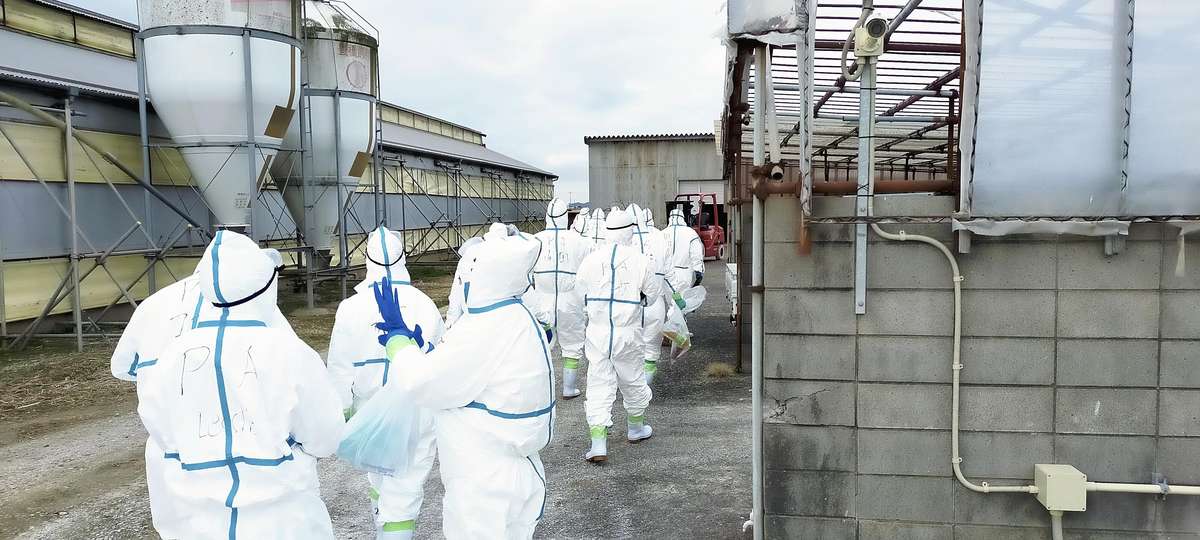
Workers enter a poultry farm in Asahi, Chiba Prefecture, to cull chickens after an outbreak of avian flu was detected there in January.
15:55 JST, April 3, 2026
Cases of highly pathogenic avian influenza have been confirmed at poultry farms and other locations in Japan for six consecutive winter seasons since 2020, and more than 30% of outbreaks detected this winter occurred at sites that have had infections before.
The Agriculture, Forestry and Fisheries Ministry has started considering vaccinating birds as a sweeping measure to deal with the problem, but there are many obstacles to implementing such a plan.
One executive at a company that operates a poultry farm in northern Japan was baffled after an outbreak of bird flu was detected at the facility in autumn 2025. “We’d implemented all sorts of measures to prevent such a thing,” the executive said. “We thought, ‘How did this happen again?’”
A bird flu outbreak had been confirmed at the same farm about four years earlier. As part of efforts to prevent a recurrence, sanitizing sprayers were installed by the windows of the farm’s chicken houses, and nets were placed over openings to stop wild birds from entering. A ministry investigation found no shortcomings in the farm’s countermeasures, and the source of the latest infection remains unclear. The farm culled about 500,000 birds after the first outbreak and has culled about 450,000 more since the latest infection was discovered.
“There are limits to the infection control measures that poultry farms can take,” the executive sighed.
The avian flu virus is carried to Japan by migratory birds that come from Siberia to spend the winter here, and it spreads among chickens and wild birds from autumn through spring.
According to the ministry, outbreaks in Japan occurred every two to three years from the time a case was detected in 2004 until 2020, since which infections have been confirmed every year. It is believed that mutations making the virus more infectious are a factor behind the increased frequency of outbreaks.
Between Oct. 22, 2025, and March 26 of this year, 23 outbreaks were detected at chicken farms and general poultry farms in 15 prefectures, including Hokkaido, Okayama and Miyazaki. A total of 5.52 million birds were culled during the season, the fourth highest number on record for a single season.
The ministry provides support for the cost of installing nets and other steps to keep out wild birds, but many poultry farms have been unable to fully prevent them from entering and have consequently suffered repeated outbreaks. Of the 23 outbreaks reported during the latest season, eight locations — or 35% — had suffered another outbreak in the past, and for two of them it was the third outbreak.
Growing calls for vaccinations
Vaccinations are now being considered as a new weapon in the fight against bird flu. Birds in Japan currently do not receive vaccinations.
According to the ministry, France began vaccinating ducks raised for human consumption in 2023. Bird flu outbreaks had sometimes exceeded 1,000 cases in previous years, but this figure has plunged to about 10 cases since the vaccination campaign was launched. The United States and Canada also are reportedly considering vaccinating poultry.
In consideration of these developments overseas, Japan’s farm ministry in August 2025 established a “technical committee” of experts to start discussing the question of vaccination. The committee will hear directly from poultry farm operators and others from April and carefully examine whether a vaccination program for birds should be rolled out.
A bird flu infection was detected at an egg farm in Miyazaki Prefecture in 2021, resulting in the culling of about 240,000 birds. Fully restoring the farm’s original egg production system took almost a year.
“I can never sleep easy during bird flu season,” egg farm’s 54-year-old operator said. “I hope these vaccinations will be allowed in Japan.”
The Japan Poultry Association also is eagerly awaiting the launch of a vaccination program. “Bold, proactive measures are essential right now,” an association official said.
Concerns over delayed detection
However, there are some wrinkles to be ironed out before bird vaccinations can be introduced in Japan.
Current vaccines cannot fully prevent birds from becoming infected. However, they do suppress symptoms in infected birds. This can result in delayed detection of flu cases, which could actually allow the virus to spread within a chicken farm and further afield. Establishing a system to closely monitor infections will therefore be necessary.
Determining which birds should be vaccinated also will be a focus of discussions. Egg-laying hens have a rearing period of about one to two years, but chickens raised for their meat have a shorter life span of about 50 days. A supplier of poultry raised for meat in Iwate Prefecture said, “Even if these birds get vaccinated, they’ll be shipped out soon after, so it wouldn’t be financially worthwhile.”
Egg prices soaring
The spread of bird flu has sent egg prices soaring.
After the 2022-23 winter season, in which a record-high 17.71 million birds were culled, major egg wholesaler JA.Z-Tamago Co. said the average wholesale price for M-size eggs in the Tokyo area hit a record high of ¥350 per kilogram in spring 2023. This was 1.6 times higher than the price at the same time the previous year and became known as “the egg shock.”
Although egg prices settled down after that, they soared again in 2025 due to the impacts of avian flu and surging production costs due to inflation. The price had climbed as high as ¥345 as of December and was still ¥320 as of Thursday.




Most Read
Most read in the last 24 hours
-
Japan Passport Fees Going Down to ¥9,000 in July
-

26-year-old U.S. National Falls While Climbing Mt. Fuji; Accompan...
-

Japanese Side Machida Zelvia Faces Ah-Ahli in Asian Champions Lea...
-

Transfer of Defense Equipment: Increase the Number of Like-minded...
-

Charm of Meiji-Era Poet Takuboku Examined from Viewpoint of Donal...
-

CARTOON OF THE DAY (April 24)
-

Japan Eyes Trialing Dual-Use Tech Developed by Startups to Promot...
-

Cherry Blossoms in Full Bloom in Hokkaido's Hakodate; Tourists Fl...
Most read in the last 7 days
-
Earthquake Hits Japan's Tohoku Region; 3-meter Tsunami Warning Is...
-

Trump Extends the Ceasefire with Iran but Keeps the Blockade
-

China, South Korea Object to Japanese PM Takaichi's Ritual Offeri...
-

India's Arms Indigenization Quest for Self-Reliance / New Delhi S...
-

Japan to Ban Use of Portable Chargers on Airplanes from April 24,...
-

¥1,000 Coins to Be Issued to Mark Anniversary of Beginning of Jap...
-

Most Serious Cyberattacks against the UK Now from Russia, Iran an...
-

New Challenges Await as Miura-Kihara Retires; Blade Maker, Ex-Coa...
Most read in the last 30 days
-
Earthquake Hits Japan's Tohoku Region; 3-meter Tsunami Warning Is...
-
Police Find Child's Shoe During Search for Missing Boy in Nantan,...
-
Body Found in Nantan, Kyoto Prefecture, During Search for 11-Year...
-
Cherry Blossoms, Rapeseed Flowers Perform Colorful ‘Duet’ in Niig...
-
Trump Extends the Ceasefire with Iran but Keeps the Blockade
-

Olympic Gold Medal-Winning Figure Skaters Riku-Ryu Announce Retir...
-
China, South Korea Object to Japanese PM Takaichi's Ritual Offeri...
-

Japanese Prime Minister Takaichi Speaks to Pakistani Prime Minist...
Top Articles in Society
-
Earthquake Hits Japan’s Tohoku Region; 3-meter Tsunami Warning Issued (Update 1)
-
Police Find Child’s Shoe During Search for Missing Boy in Nantan, Kyoto Prefecture
-
Body Found in Nantan, Kyoto Prefecture, During Search for 11-Year-Old Boy in Area (Update 1)
-
Cherry Blossoms, Rapeseed Flowers Perform Colorful ‘Duet’ in Niigata
-

Two Women in Osaka Found Lying on Floor Bleeding, Later Pronounced Dead
JN ACCESS RANKING
-
Earthquake Hits Japan’s Tohoku Region; 3-meter Tsunami Warning Issued (Update 1)
-
Police Find Child’s Shoe During Search for Missing Boy in Nantan, Kyoto Prefecture
-
Body Found in Nantan, Kyoto Prefecture, During Search for 11-Year-Old Boy in Area (Update 1)
-
Cherry Blossoms, Rapeseed Flowers Perform Colorful ‘Duet’ in Niigata
-
Trump Extends the Ceasefire with Iran but Keeps the Blockade
Most read in the last 24 hours
-
Japan Passport Fees Going Down to ¥9,000 in July
-
26-year-old U.S. National Falls While Climbing Mt. Fuji; Accompan...
-
Japanese Side Machida Zelvia Faces Ah-Ahli in Asian Champions Lea...
-
Transfer of Defense Equipment: Increase the Number of Like-minded...
-
Charm of Meiji-Era Poet Takuboku Examined from Viewpoint of Donal...
Most read in the last 7 days
-
Earthquake Hits Japan's Tohoku Region; 3-meter Tsunami Warning Is...
-
Trump Extends the Ceasefire with Iran but Keeps the Blockade
-
China, South Korea Object to Japanese PM Takaichi's Ritual Offeri...
-
India's Arms Indigenization Quest for Self-Reliance / New Delhi S...
-
Japan to Ban Use of Portable Chargers on Airplanes from April 24,...
Most read in the last 30 days
-
Earthquake Hits Japan's Tohoku Region; 3-meter Tsunami Warning Is...
-
Police Find Child's Shoe During Search for Missing Boy in Nantan,...
-
Body Found in Nantan, Kyoto Prefecture, During Search for 11-Year...
-
Cherry Blossoms, Rapeseed Flowers Perform Colorful ‘Duet’ in Niig...
-
Trump Extends the Ceasefire with Iran but Keeps the Blockade