
Agricultural Land in Fukushima Converted to Solar Farms, Bringing Unsightly Sprawl
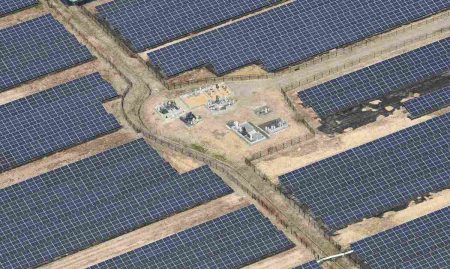
A cemetery surrounded by a mega-solar farm in Namie, Fukushima Prefecture, on March 1
15:51 JST, March 24, 2026
Solar panels have been installed across more than seven square kilometers of farmland in Fukushima Prefecture since the 2011 Great East Japan Earthquake, an analysis of satellite data by The Yomiuri Shimbun has found. Of this, 4.7 square kilometers is concentrated in the 12 municipalities surrounding the Fukushima No. 1 nuclear power plant.
Offers of farmland to developers are believed to have surged as evacuation orders dragged on in some areas. However, there are also concerns that the spread of solar panels could hinder agriculture and rebuilding in these communities.
The analysis used the High-Resolution Land-Use and Land-Cover Map released by the Japan Aerospace Exploration Agency. In creating the map, AI was used to analyze images on the Earth captured by the satellites of Japan and other countries, and land use is shown by color in grids with 10-meter-square cells.
The Yomiuri calculated the area of farmland that was rice paddies and agricultural fields before the disaster and that had been converted to solar panels as of 2024.
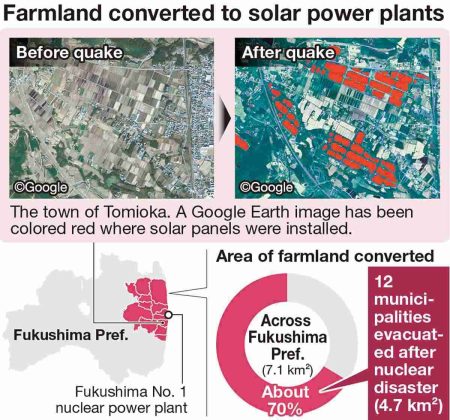
Solar panels were found to have been installed on 7.1 square kilometers of farmland across Fukushima Prefecture. About 70% of this area — 4.7 square kilometers — was concentrated in 12 municipalities, including Namie and Minami-Soma, where evacuation orders were issued by the central government and other authorities after the nuclear accident.
Before the disaster, rice cultivation flourished in this region thanks to the mild climate, but a vast extent of farmland — equivalent to 100 Tokyo Domes — has now been covered with solar panels.
Evacuation directives have been lifted except in some high-radiation areas. However, more than a decade has passed since the disaster, and many residents settled where they evacuated to, relinquishing their farmland or terminating their businesses due to a lack of successors.
More than a few residents are believed to have cooperated with the installation of solar panels, such as by leasing their unused farmland to developers.
Solar panels have sprung up haphazardly across the region, including as mega-solar farms installed in the middle of farmland or surrounding cemeteries.
Some residents have voiced concern, with one saying, “This not only spoils the landscape but also hinders a return to farming and makes it less appealing to come back.”
In 2012, the Fukushima prefectural government situated renewable energy, such as solar power, as a central part of its reconstruction efforts, setting a goal of generating more than 100% of the prefecture’s electricity demand from renewable sources by around 2040.
Satellite analysis also found that when one includes non-farmland, the area converted to solar panels after the disaster rises to 31.9 square kilometers across the prefecture.
Forests accounted for the largest share of converted land — 40% of the total. However, in the 12 municipalities around the nuclear power plant, farmland accounted for a conspicuous 60% of converted land. This may be due to the unique circumstances following the nuclear accident that have made it difficult to maintain farmland.
Nationwide, there have been many disputes between locals and solar panel operators over such issues as the degrading of landscapes and power equipment being abandoned. Getting renewable energy sources and communities to coexist has proved a challenge across Japan.
Tsunehide Chino, a professor of environmental sociology at Hosei University, said, “We should strive to build consensus across the entire region to ensure that residents are not divided by the promotion of renewable energy.”


Related Tags

Most Read
Most read in the last 24 hours
-

Tohoku, Hokkaido Tourist Sites Prepare to Evacuate Visitors in Ca...
-

India's Arms Indigenization Quest for Self-Reliance / Desert Dril...
-

26-year-old U.S. National Falls While Climbing Mt. Fuji; Accompan...
-
Japan Passport Fees Going Down to ¥9,000 in July
-

Japanese Side Machida Zelvia Faces Ah-Ahli in Asian Champions Lea...
-

Japan Eyes Trialing Dual-Use Tech Developed by Startups to Promot...
-

Charm of Meiji-Era Poet Takuboku Examined from Viewpoint of Donal...
-

Transfer of Defense Equipment: Increase the Number of Like-minded...
Most read in the last 7 days
-
Earthquake Hits Japan's Tohoku Region; 3-meter Tsunami Warning Is...
-

Trump Extends the Ceasefire with Iran but Keeps the Blockade
-

China, South Korea Object to Japanese PM Takaichi's Ritual Offeri...
-

India's Arms Indigenization Quest for Self-Reliance / New Delhi S...
-

Japan to Ban Use of Portable Chargers on Airplanes from April 24,...
-

¥1,000 Coins to Be Issued to Mark Anniversary of Beginning of Jap...
-

Most Serious Cyberattacks against the UK Now from Russia, Iran an...
-

New Challenges Await as Miura-Kihara Retires; Blade Maker, Ex-Coa...
Most read in the last 30 days
-
Earthquake Hits Japan's Tohoku Region; 3-meter Tsunami Warning Is...
-
Police Find Child's Shoe During Search for Missing Boy in Nantan,...
-
Body Found in Nantan, Kyoto Prefecture, During Search for 11-Year...
-
Cherry Blossoms, Rapeseed Flowers Perform Colorful ‘Duet’ in Niig...
-
Trump Extends the Ceasefire with Iran but Keeps the Blockade
-

Olympic Gold Medal-Winning Figure Skaters Riku-Ryu Announce Retir...
-

Nori Prices Surge in Japan Due to Poor Seaweed Production Amid Ri...
-

Japanese Prime Minister Takaichi Speaks to Pakistani Prime Minist...
Top Articles in Society
-
Earthquake Hits Japan’s Tohoku Region; 3-meter Tsunami Warning Issued (Update 1)
-
Police Find Child’s Shoe During Search for Missing Boy in Nantan, Kyoto Prefecture
-
Body Found in Nantan, Kyoto Prefecture, During Search for 11-Year-Old Boy in Area (Update 1)
-
Cherry Blossoms, Rapeseed Flowers Perform Colorful ‘Duet’ in Niigata
-

Two Women in Osaka Found Lying on Floor Bleeding, Later Pronounced Dead
JN ACCESS RANKING
-
Earthquake Hits Japan’s Tohoku Region; 3-meter Tsunami Warning Issued (Update 1)
-
Police Find Child’s Shoe During Search for Missing Boy in Nantan, Kyoto Prefecture
-
Body Found in Nantan, Kyoto Prefecture, During Search for 11-Year-Old Boy in Area (Update 1)
-
Cherry Blossoms, Rapeseed Flowers Perform Colorful ‘Duet’ in Niigata
-
Trump Extends the Ceasefire with Iran but Keeps the Blockade
Most read in the last 24 hours
-
Tohoku, Hokkaido Tourist Sites Prepare to Evacuate Visitors in Ca...
-
India's Arms Indigenization Quest for Self-Reliance / Desert Dril...
-
26-year-old U.S. National Falls While Climbing Mt. Fuji; Accompan...
-
Japan Passport Fees Going Down to ¥9,000 in July
-
Japanese Side Machida Zelvia Faces Ah-Ahli in Asian Champions Lea...
Most read in the last 7 days
-
Earthquake Hits Japan's Tohoku Region; 3-meter Tsunami Warning Is...
-
Trump Extends the Ceasefire with Iran but Keeps the Blockade
-
China, South Korea Object to Japanese PM Takaichi's Ritual Offeri...
-
India's Arms Indigenization Quest for Self-Reliance / New Delhi S...
-
Japan to Ban Use of Portable Chargers on Airplanes from April 24,...
Most read in the last 30 days
-
Earthquake Hits Japan's Tohoku Region; 3-meter Tsunami Warning Is...
-
Police Find Child's Shoe During Search for Missing Boy in Nantan,...
-
Body Found in Nantan, Kyoto Prefecture, During Search for 11-Year...
-
Cherry Blossoms, Rapeseed Flowers Perform Colorful ‘Duet’ in Niig...
-
Trump Extends the Ceasefire with Iran but Keeps the Blockade