
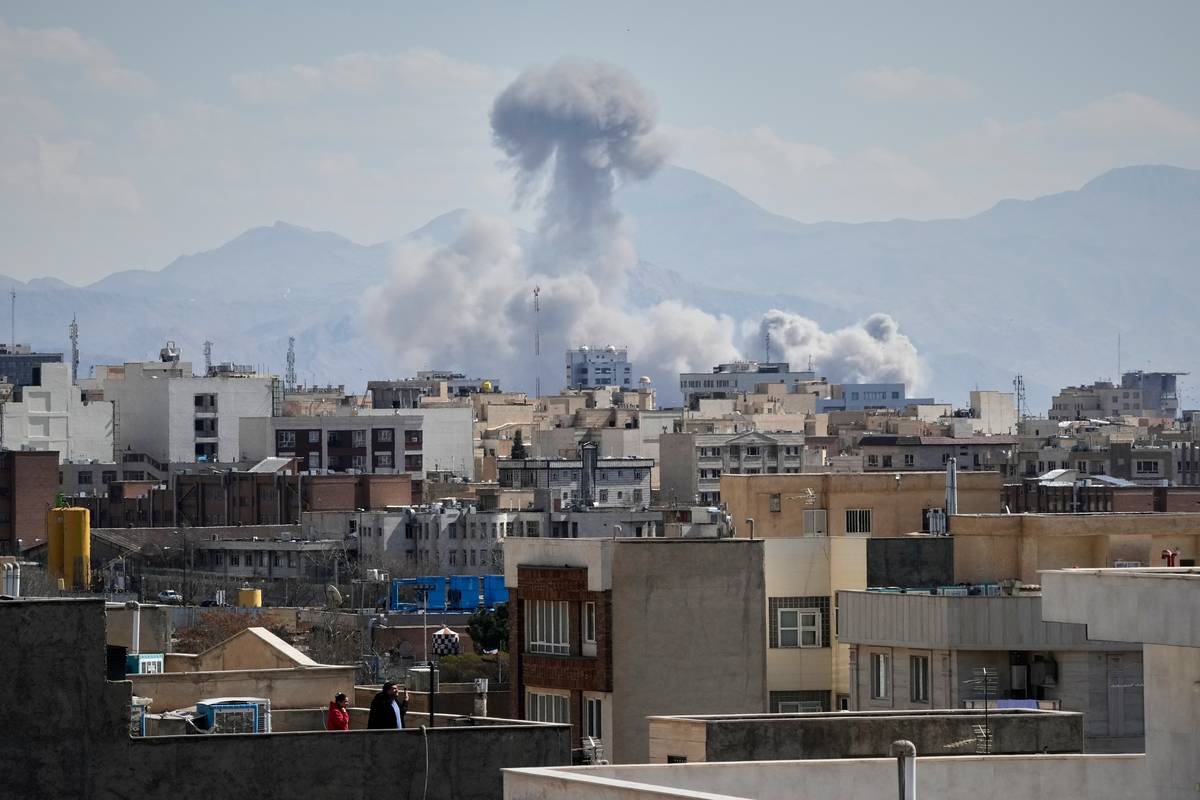
People watch from a rooftop as a plume of smoke rises after a strike in Tehran, Iran, Sunday, March 1, 2026.
10:24 JST, March 2, 2026
The U.S. and Israeli attack on Iran killed Supreme Leader Ayatollah Ali Khamenei, triggered retaliatory strikes on multiple countries in the region and is reverberating around the world.
Related violence expanded Sunday to a growing number of places, with a rising death toll. Israeli strikes targeted Tehran. Iran fired drones and missiles at Israel and sites around the Gulf, prompting three close U.S. allies to say they are ready to defend their interests in the region.
The joint U.S.-Israeli strikes on Iran, which started Saturday, stoked fears of a wider war and damage to the world economy. Global reaction ranged from jubilation to condemnation.
The strikes came two days after the latest U.S.-Iran talks, as Trump pressured Tehran for a deal to constrain its nuclear program. A senior White House official said Sunday that “new potential leadership” in Iran has suggested they are open for talks with the U.S. and that President Donald Trump says he is “eventually” willing to talk. The official said on condition of anonymity to discuss internal administration deliberations.
For now, though, Trump said in a video posted Sunday that the operation in Iran — “one of the most complex, most overwhelming military offensives the world has ever seen” — will continue until “all of our objectives” are achieved.
Iran’s provisional governing council started its work Sunday and is expected to name a new supreme leader. Iran’s theocracy has struggled with growing dissent following nationwide protests over the economy that morphed into anti-government ones.
In Tehran on Sunday, the streets were largely deserted as people sheltered during heavy airstrikes, witnesses told The Associated Press, speaking anonymously for fear of retribution.
Khamenei killed in one of first strikes
Israel said it had worked with the U.S. for months to plan the attacks. The U.S. military said targets in Iran included Revolutionary Guard command facilities, air defense capabilities, missile and drone launch sites and military airfields.
One of the first strikes hit near the offices of the 86-year-old Khamenei, who had ruled since 1989 and held ultimate power. Iranian state media reported Khamenei’s death, without details. Israel said that it also killed dozens of other top Iranian military officials.
Iranian state media said more than 200 people have been killed. In southern Iran, at least 165 people were killed when a girls’ school was struck, the state-run IRNA news agency reported. The Israeli military said it was not aware of strikes in the area. The U.S. military said it was looking into the reports.
The U.S. and Israel also struck Iran last June during earlier nuclear talks and claimed to have weakened Iran’s air defenses, military leadership and nuclear program. The Trump administration has asserted that Iran had been rebuilding its nuclear program, which Tehran has insisted is for peaceful purposes.
Omani Foreign Minister Badr al-Busaidi, who had mediated nuclear negotiations between the U.S. and Iran, said after the second full day of hostilities that “the door to diplomacy remains open.”
“Although the hope was to avoid war, war should not mean that the hope of peace is extinguished,” he wrote on X. “The sooner talks are resumed the better it is for everyone.”
Iran strikes at Israel and US bases in retaliation
Iran launched retaliatory missiles and drones targeting Israel and nearby Arab Gulf countries hosting U.S. forces. Three U.S. service members have been killed, according to U.S. Central Command.
“You have crossed our red line and must pay the price,” Iran’s parliamentary speaker, Mohammad Bagher Qalibaf, said in a televised address Sunday.
Iranian Foreign Minister Abbas Araghchi called on the United Nations to ensure accountability from the U.S. and Israel for their role in Khamenei’s killing. He wrote in a letter Sunday that such conduct “recklessly opens a dangerous Pandora’s box, eroding the bedrock of sovereign equality and the stability of the international system.”
Eleven people have been killed in Israel as loud explosions caused by missile impacts or interceptions could be heard in Tel Aviv. Israel’s rescue services said that nine people were killed and more wounded in a strike that hit a synagogue in the central town of Beit Shemesh.
Iranian-backed Houthis in Yemen have vowed to resume attacks on Red Sea shipping routes and on Israel, according to two senior Houthi officials who spoke on condition of anonymity because there was no official announcement from leadership.
US says military force will continue and allies weigh in
Trump listed grievances stretching back to the beginning of the Islamic Republic following a revolution in 1979 that turned Iran from one of America’s closest allies in the Middle East into a foe. Iran’s ballistic missile program and support for armed proxies in the region were other issues he cited.
Tensions had escalated in recent weeks as the Trump administration built up the largest force of American warships and aircraft in the Middle East in decades.
Trump said “heavy and pinpoint bombing” in Iran would continue through the week or longer. He told Iranians to take cover, but urged them to later rise up and topple the Islamic leadership.
Trump also acknowledged in a video posted Sunday that there would likely be more American troops killed.
Britain, France and Germany said in a joint statement Sunday that they are ready to work with the U.S. and its partners to help stop Iran’s retaliatory missile and drone strikes.
The statement by British Prime Minister Keir Starmer, French President Emmanuel Macron and German Chancellor Friedrich Merz said they are “appalled” by Iran’s “reckless” strikes on their allies, which threaten their service members and citizens in the region.
“We will take steps to defend our interests and those of our allies in the region, potentially through enabling necessary and proportionate defensive action to destroy Iran’s capability to fire missiles and drones at their source,” their statement said. “We have agreed to work together with the US and allies in the region on this matter.”
Strikes’ impact reverberates around the world
The strikes elicited mixed global reactions, including angry protests, celebrations and calls by world leaders for a return to negotiations and peace.
At least 22 people were killed in clashes with police in northern Pakistan and in the southern port city of Karachi after hundreds of protesters stormed the U.S. Consulate there, authorities said.
Shipping companies suspended their vessels’ traffic through the Suez Canal. The strikes could rattle global markets, particularly if Iran makes the Strait of Hormuz unsafe for commercial traffic. A fifth of worldwide traded oil passes through the strait.
There were global repercussions from disrupted air travel in the region, with hundreds of thousands of travelers stranded or diverted to other airports after Israel, Qatar, Syria, Iran, Iraq, Kuwait and Bahrain closed their airspace.






Most Read
Most read in the last 24 hours
-

Govt May Revise Law to Allow Export of Defense Equipment for Free
-

Undrafted Japanese Kicker Signs with Raiders; ‘My Appeal Is My Ac...
-

Number of Immigration Officer-Escorted Forced Deportations in Jap...
-
Spring Bear Hunting Gets Fully Underway As Prefectures Deal With ...
-

Dutch Man Injured on Closed Mt. Fuji Route, Having Fallen While D...
-

Princess Aiko Enjoys Imperial Court Music, Dance; Production, Cos...
-

Mother Supports My Sister Too Much, Gives Her Kids Much More Than...
-

Sabastian Sawe of Kenya Becomes First Person to Run a Sub-2-hour ...
Most read in the last 7 days
-
Earthquake Hits Japan's Tohoku Region; 3-meter Tsunami Warning Is...
-

China, South Korea Object to Japanese PM Takaichi's Ritual Offeri...
-

Trump Extends the Ceasefire with Iran but Keeps the Blockade
-
India's Arms Indigenization Quest for Self-Reliance / New Delhi S...
-

¥1,000 Coins to Be Issued to Mark Anniversary of Beginning of Jap...
-

Most Serious Cyberattacks against the UK Now from Russia, Iran an...
-

Trump Opposes United–American Merger, Signals Support for Spirit
-
System Malfunction in Haneda Airport Causes 83 Flight Cancelation...
Most read in the last 30 days
-
Earthquake Hits Japan's Tohoku Region; 3-meter Tsunami Warning Is...
-
Police Find Child's Shoe During Search for Missing Boy in Nantan,...
-
Body Found in Nantan, Kyoto Prefecture, During Search for 11-Year...
-
China, South Korea Object to Japanese PM Takaichi's Ritual Offeri...
-

Cherry Blossoms, Rapeseed Flowers Perform Colorful ‘Duet’ in Niig...
-
Trump Extends the Ceasefire with Iran but Keeps the Blockade
-

Olympic Gold Medal-Winning Figure Skaters Riku-Ryu Announce Retir...
-

Japanese Prime Minister Takaichi Speaks to Pakistani Prime Minist...
Top Articles in News Services
-
Trump Extends the Ceasefire with Iran but Keeps the Blockade
-
Most Serious Cyberattacks against the UK Now from Russia, Iran and China, Cyber Chief Says
-
Trump Opposes United–American Merger, Signals Support for Spirit
-

Florida Launches Criminal Probe into OpenAI and ChatGPT over Deadly Shooting
-

Trump Picks a University of Minnesota Professor to Lead His Economic Council
JN ACCESS RANKING
-
Earthquake Hits Japan’s Tohoku Region; 3-meter Tsunami Warning Issued (Update 1)
-
Police Find Child’s Shoe During Search for Missing Boy in Nantan, Kyoto Prefecture
-
Body Found in Nantan, Kyoto Prefecture, During Search for 11-Year-Old Boy in Area (Update 1)
-
China, South Korea Object to Japanese PM Takaichi’s Ritual Offering to Yasukuni Shrine
-
Cherry Blossoms, Rapeseed Flowers Perform Colorful ‘Duet’ in Niigata
Most read in the last 24 hours
-
Govt May Revise Law to Allow Export of Defense Equipment for Free
-
Undrafted Japanese Kicker Signs with Raiders; ‘My Appeal Is My Ac...
-
Number of Immigration Officer-Escorted Forced Deportations in Jap...
-
Spring Bear Hunting Gets Fully Underway As Prefectures Deal With ...
-
Dutch Man Injured on Closed Mt. Fuji Route, Having Fallen While D...
Most read in the last 7 days
-
Earthquake Hits Japan's Tohoku Region; 3-meter Tsunami Warning Is...
-
China, South Korea Object to Japanese PM Takaichi's Ritual Offeri...
-
Trump Extends the Ceasefire with Iran but Keeps the Blockade
-
India's Arms Indigenization Quest for Self-Reliance / New Delhi S...
-
¥1,000 Coins to Be Issued to Mark Anniversary of Beginning of Jap...
Most read in the last 30 days
-
Earthquake Hits Japan's Tohoku Region; 3-meter Tsunami Warning Is...
-
Police Find Child's Shoe During Search for Missing Boy in Nantan,...
-
Body Found in Nantan, Kyoto Prefecture, During Search for 11-Year...
-
China, South Korea Object to Japanese PM Takaichi's Ritual Offeri...
-
Cherry Blossoms, Rapeseed Flowers Perform Colorful ‘Duet’ in Niig...