
Rare Bird, Returned to Wild, Found to Have Successfully Overwintered; ‘Endangered’ Species May Be Revised to ‘Vulnerable’
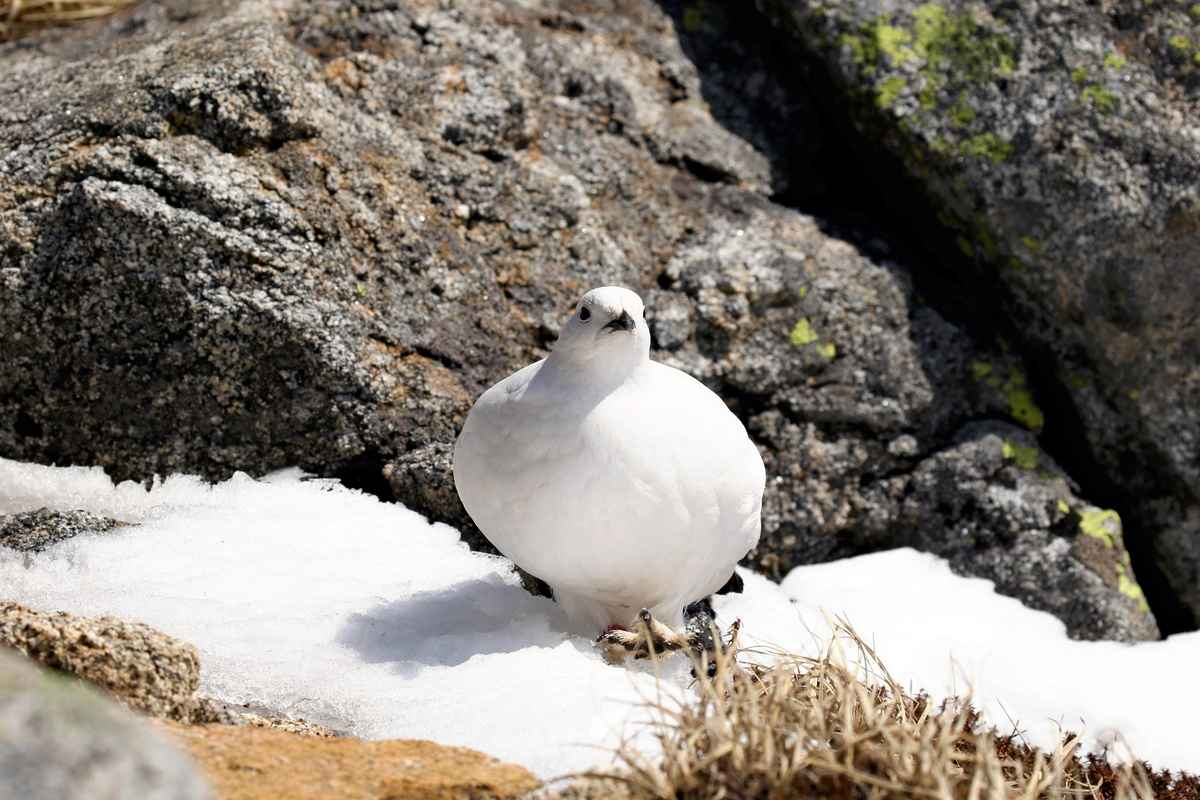
A Japanese rock ptarmigan that was found to have overwintered on Mt. Kisokomagatake in the Central Japanese Alps
11:00 JST, May 3, 2025
NAGANO — One of seven artificially hatched Japanese rock ptarmigan chicks was found to have overwintered in the Central Japanese Alps, indicating that an Environment Ministry project to revive the species in the area is making progress, the ministry has announced.
The development is expected to reduce the risk of extinction for the rare wild bird species, which has been designated a special natural treasure by the government and was once thought to be extinct in the mountainous region.
The chicks, including the female one that overwintered, had been artificially hatched in zoos and released into the wild at the Central Japanese Alps in autumn last year, according to the ministry’s announcement in March.
Japanese rock ptarmigan, called “nihon raicho” or “raicho” in Japanese, inhabit only the alpine region of central Honshu. In the 1980s, their number was estimated at 3,000. By the early 2000s, the number had declined to about 1,700, mainly due to such predators as martens and foxes, which invaded the alpine region.
On the ministry’s Red List, the species is classified as “Endangered” with a high risk of extinction in the near future.
The project was prompted by the 2018 discovery of a female Japanese rock ptarmigan on the 2,956-meter-high Mt. Kisokomagatake in the Central Japanese Alps. The bird is believed to have flown from the 3,026-meter-high Mt. Norikura in the Northern Japanese Alps about 40 kilometers away.
It was thought that the species had been gone from the Central Japanese Alps since 1969, with experts believing that the environment had become unsuitable. The 2018 discovery overturned this belief.
The ministry relocated some adults and chicks of the species from Mt. Norikura to Mt. Kisokomagatake and transferred some to zoos to be bred and returned to Mt. Kisokomagatake. The number of the species has now increased to about 130.
The seven chicks returned to the wild in this project originated from birds that had been artificially hatched from eggs collected from Mt. Norikura in 2015 and 2016 and bred for several generations in zoos.
By eating their mother’s feces, the chicks are thought to get intestinal bacteria capable of breaking down the toxins contained in the alpine plants that they eat. However, the artificially hatched chicks lack these bacteria. The problem was solved by feeding the chicks the dried feces of adults in the wild.
In September last year, the seven chicks that had been artificially hatched at zoos in Omachi, Nagano Prefecture, and other places were released near the summit of Mt. Kisokomagatake. Four of them were found to be alive at the end of October.
On March 26, the ministry announced that one of the four chicks had survived the winter and that it was eating alpine plants and always with a male that was not one of the released chicks.
It is hoped that the couple’s chicks will hatch from spring through summer.
“If this project succeeds, we will have established a technology to prevent extinction,” said Shinshu University Prof. Emeritus Hiroshi Nakamura, an expert in avian ecology who has been leading the project. “By breeding the species in zoos, our long-held dream [of reviving the species in the Central Japanese Alps] is about to be realized.”
The ministry will continue to study the species’ condition and, depending on the results, consider lowering its Red List category by one level to “Vulnerable” in fiscal 2029 at the earliest.






Most Read
Most read in the last 24 hours
-

Govt May Revise Law to Allow Export of Defense Equipment for Free
-

Number of Immigration Officer-Escorted Forced Deportations in Jap...
-

Undrafted Japanese Kicker Signs with Raiders; ‘My Appeal Is My Ac...
-

Dutch Man Injured on Closed Mt. Fuji Route, Having Fallen While D...
-
Spring Bear Hunting Gets Fully Underway As Prefectures Deal With ...
-

Tokyo Vice Governor: Sushi Tech Tokyo Garners Tangible Business O...
-

Mother Supports My Sister Too Much, Gives Her Kids Much More Than...
-

Japan to Host Leaders from Major Cities from Around the World for...
Most read in the last 7 days
-
Earthquake Hits Japan's Tohoku Region; 3-meter Tsunami Warning Is...
-

China, South Korea Object to Japanese PM Takaichi's Ritual Offeri...
-

Trump Extends the Ceasefire with Iran but Keeps the Blockade
-

India's Arms Indigenization Quest for Self-Reliance / New Delhi S...
-

¥1,000 Coins to Be Issued to Mark Anniversary of Beginning of Jap...
-

Most Serious Cyberattacks against the UK Now from Russia, Iran an...
-

Trump Opposes United–American Merger, Signals Support for Spirit
-

System Malfunction in Haneda Airport Causes 83 Flight Cancelation...
Most read in the last 30 days
-
Earthquake Hits Japan's Tohoku Region; 3-meter Tsunami Warning Is...
-

Police Find Child's Shoe During Search for Missing Boy in Nantan,...
-

Body Found in Nantan, Kyoto Prefecture, During Search for 11-Year...
-
China, South Korea Object to Japanese PM Takaichi's Ritual Offeri...
-

Cherry Blossoms, Rapeseed Flowers Perform Colorful ‘Duet’ in Niig...
-
Trump Extends the Ceasefire with Iran but Keeps the Blockade
-

Olympic Gold Medal-Winning Figure Skaters Riku-Ryu Announce Retir...
-

Japanese Prime Minister Takaichi Speaks to Pakistani Prime Minist...
Top Articles in Science & Nature
-

Japan’s Panasonic Develops Automated System to Produce Ips Cells from Patient’s Blood
-

Govt Aims to Establish Bear Population Control by FY30, Hopes to Achieve ‘Coexistence’ with Bears
-

Punch The Monkey Getting Used to Life Without Stuffed ‘Mother’
-

‘Electric Aircraft’ to Begin Test Flights from Kitakyushu Airport, Aiming for Practical Use in Cargo Transport Route
-

New Robotics Center to Conduct Experiments Around the Clock; New Facility Aims to Accelerate Research Efforts
JN ACCESS RANKING
-
Earthquake Hits Japan’s Tohoku Region; 3-meter Tsunami Warning Issued (Update 1)
-
Police Find Child’s Shoe During Search for Missing Boy in Nantan, Kyoto Prefecture
-
Body Found in Nantan, Kyoto Prefecture, During Search for 11-Year-Old Boy in Area (Update 1)
-
China, South Korea Object to Japanese PM Takaichi’s Ritual Offering to Yasukuni Shrine
-
Cherry Blossoms, Rapeseed Flowers Perform Colorful ‘Duet’ in Niigata
Most read in the last 24 hours
-
Govt May Revise Law to Allow Export of Defense Equipment for Free
-
Number of Immigration Officer-Escorted Forced Deportations in Jap...
-
Undrafted Japanese Kicker Signs with Raiders; ‘My Appeal Is My Ac...
-
Dutch Man Injured on Closed Mt. Fuji Route, Having Fallen While D...
-
Spring Bear Hunting Gets Fully Underway As Prefectures Deal With ...
Most read in the last 7 days
-
Earthquake Hits Japan's Tohoku Region; 3-meter Tsunami Warning Is...
-
China, South Korea Object to Japanese PM Takaichi's Ritual Offeri...
-
Trump Extends the Ceasefire with Iran but Keeps the Blockade
-
India's Arms Indigenization Quest for Self-Reliance / New Delhi S...
-
¥1,000 Coins to Be Issued to Mark Anniversary of Beginning of Jap...
Most read in the last 30 days
-
Earthquake Hits Japan's Tohoku Region; 3-meter Tsunami Warning Is...
-
Police Find Child's Shoe During Search for Missing Boy in Nantan,...
-
Body Found in Nantan, Kyoto Prefecture, During Search for 11-Year...
-
China, South Korea Object to Japanese PM Takaichi's Ritual Offeri...
-
Cherry Blossoms, Rapeseed Flowers Perform Colorful ‘Duet’ in Niig...