
Japanese Surgeon Recounts Myanmar Quake Relief Mission; Extreme Heat, Sudden Storms Complicated Treatment
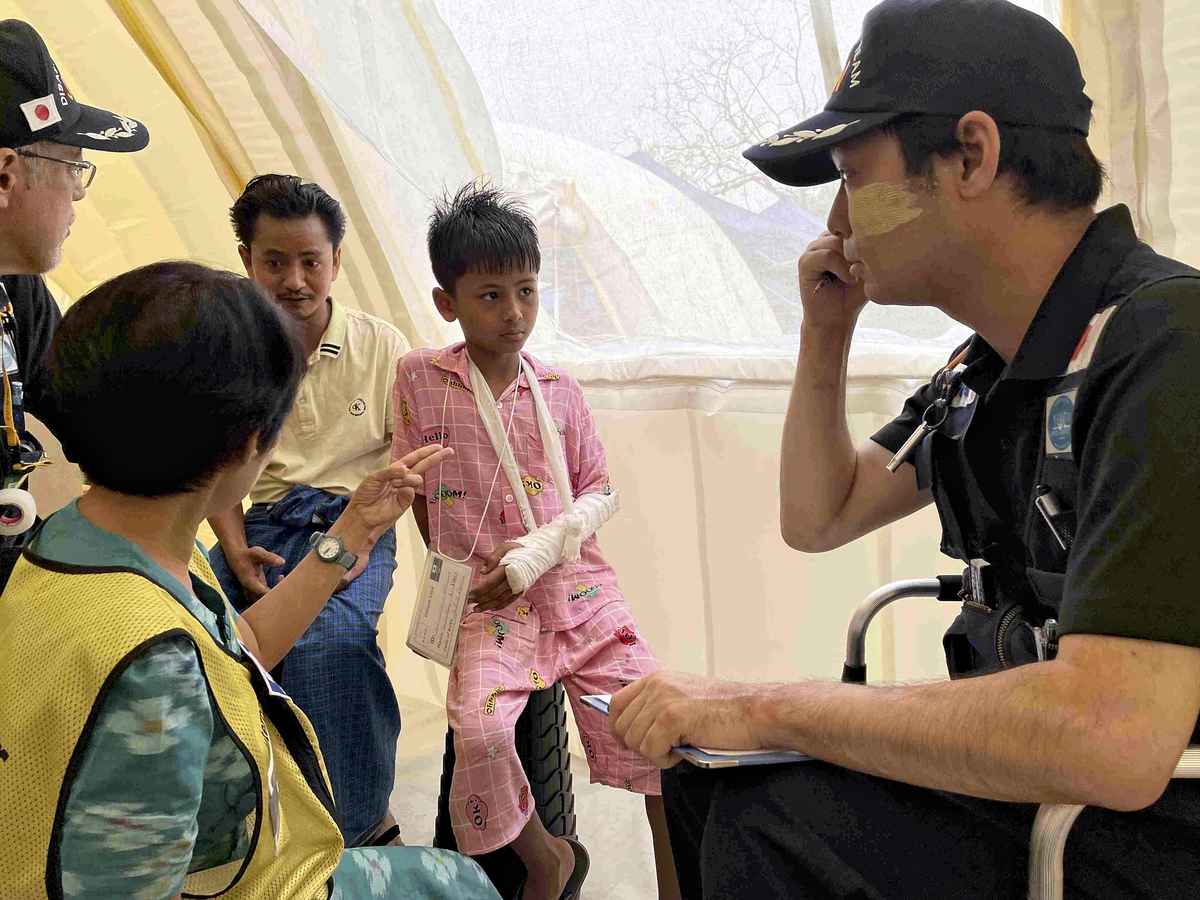
Trauma surgeon Ryohei Kosaki examines a child with fractures inside a Japan Disaster Relief (JDR) medical tent in Mandalay, Myanmar, on April 7.
20:00 JST, April 30, 2025
In the face of scorching heat and a severely challenging environment, a Japanese disaster relief team provided medical care to about 100 people a day in Myanmar following the powerful magnitude 7.7 earthquake that struck the country’s central region on March 28.
The first Japan Disaster Relief (JDR) team, which returned to Japan in mid-April, included Ryohei Kosaki, a trauma surgeon from the National Hospital Organization Disaster Medical Center in Tachikawa, Tokyo. Kosaki later reflected on the team’s challenging mission amidst intense heat.
The initial deployment, consisting of 32 medical professionals, including doctors and nurses, departed from Haneda Airport on April 2.
Their mission in the disaster-stricken region near the Mandalay epicenter lasted from April 4 to 14, when they handed over operations to the second team.
They traveled about 600 kilometers from Yangon, the largest city, via Naypyitaw, the capital, using two buses and six trucks to transport 10 tons of equipment, including medical devices.
They faced extreme heat upon arrival, with temperatures reaching 40 C on their first day and remaining above 35 C in the following days, Kosaki said.
Collapsed buildings remained in the area, and a medical tent was set up in the courtyard of Mandalay City Hall. Medical supplies airlifted by the Japan Air Self-Defense Force arrived during their mission. Water purified by a water purification system brought from Japan was used for treatment.
A steady stream of injured people sought aid at the medical tent. “Initially, we saw many patients with fractures and trauma, but as time went on, an increasing number presented with preexisting conditions,” Kosaki noted.
There were physical injuries from falling debris and falls. Some patients also reported insomnia and anxiety as a result of aftershocks.
While local hospitals performed surgeries, the first JDR team provided general medical care and attended to about 100 patients daily. Throughout their deployment, they treated about 1,200 patients. The most significant obstacle they faced was the harsh local climate. “Inside the tent, the temperature reached 50 C,” Kosaki said.
The lack of refrigeration posed a challenge when it came to storing temperature-sensitive medications and test reagents. Consequently, the portable air cooler they brought was essential for cooling equipment, such as the X-ray machine, rather than for cooling patients or staff. Nighttime squalls flooded some tents, requiring them to be re-pitched, he said.
Kosaki was particularly concerned that many people with preexisting conditions were unaware of their illnesses or medications.
This experience underscores the urgent need for people in disaster-prone Japan to be prepared, given that disasters can occur without warning anywhere in the country.
“In addition to securing water and food supplies and establishing family meeting points, being aware of one’s health status is critical to disaster preparedness,” he said.




Most Read
Most read in the last 24 hours
-

Govt May Revise Law to Allow Export of Defense Equipment for Free
-

Undrafted Japanese Kicker Signs with Raiders; ‘My Appeal Is My Ac...
-
Number of Immigration Officer-Escorted Forced Deportations in Jap...
-
Spring Bear Hunting Gets Fully Underway As Prefectures Deal With ...
-

Princess Aiko Enjoys Imperial Court Music, Dance; Production, Cos...
-

Shifts Startup Focus to Nurturing Global Winners
-

Mother Supports My Sister Too Much, Gives Her Kids Much More Than...
-

Bibimbap with Spring Vegetables and Asari Clam Miso a Rich Taste ...
Most read in the last 7 days
-
Earthquake Hits Japan's Tohoku Region; 3-meter Tsunami Warning Is...
-

China, South Korea Object to Japanese PM Takaichi's Ritual Offeri...
-

Trump Extends the Ceasefire with Iran but Keeps the Blockade
-

India's Arms Indigenization Quest for Self-Reliance / New Delhi S...
-
¥1,000 Coins to Be Issued to Mark Anniversary of Beginning of Jap...
-

Most Serious Cyberattacks against the UK Now from Russia, Iran an...
-

Trump Opposes United–American Merger, Signals Support for Spirit
-
System Malfunction in Haneda Airport Causes 83 Flight Cancelation...
Most read in the last 30 days
-
Earthquake Hits Japan's Tohoku Region; 3-meter Tsunami Warning Is...
-
Police Find Child's Shoe During Search for Missing Boy in Nantan,...
-
Body Found in Nantan, Kyoto Prefecture, During Search for 11-Year...
-
China, South Korea Object to Japanese PM Takaichi's Ritual Offeri...
-
Cherry Blossoms, Rapeseed Flowers Perform Colorful ‘Duet’ in Niig...
-
Trump Extends the Ceasefire with Iran but Keeps the Blockade
-

Olympic Gold Medal-Winning Figure Skaters Riku-Ryu Announce Retir...
-

Japanese Prime Minister Takaichi Speaks to Pakistani Prime Minist...
Top Articles in World
-
China, South Korea Object to Japanese PM Takaichi’s Ritual Offering to Yasukuni Shrine
-
Japanese Prime Minister Takaichi Speaks to Pakistani Prime Minister Sharif, Emphasizes Importance of Reaching Agreement Through Dialogue
-

Japan Ekiden Road Relay Race Held near New Delhi to Deepen Japan-India Exchanges
-

Used School Backpacks Ready to Be Shipped to Afghanistan
-

Ishiba, Lee Meet in Seoul, Agree to Continue Future-Oriented, Cooperative Relations
JN ACCESS RANKING
-
Earthquake Hits Japan’s Tohoku Region; 3-meter Tsunami Warning Issued (Update 1)
-
Police Find Child’s Shoe During Search for Missing Boy in Nantan, Kyoto Prefecture
-
Body Found in Nantan, Kyoto Prefecture, During Search for 11-Year-Old Boy in Area (Update 1)
-
China, South Korea Object to Japanese PM Takaichi’s Ritual Offering to Yasukuni Shrine
-
Cherry Blossoms, Rapeseed Flowers Perform Colorful ‘Duet’ in Niigata
Most read in the last 24 hours
-
Govt May Revise Law to Allow Export of Defense Equipment for Free
-
Undrafted Japanese Kicker Signs with Raiders; ‘My Appeal Is My Ac...
-
Number of Immigration Officer-Escorted Forced Deportations in Jap...
-
Spring Bear Hunting Gets Fully Underway As Prefectures Deal With ...
-
Princess Aiko Enjoys Imperial Court Music, Dance; Production, Cos...
Most read in the last 7 days
-
Earthquake Hits Japan's Tohoku Region; 3-meter Tsunami Warning Is...
-
China, South Korea Object to Japanese PM Takaichi's Ritual Offeri...
-
Trump Extends the Ceasefire with Iran but Keeps the Blockade
-
India's Arms Indigenization Quest for Self-Reliance / New Delhi S...
-
¥1,000 Coins to Be Issued to Mark Anniversary of Beginning of Jap...
Most read in the last 30 days
-
Earthquake Hits Japan's Tohoku Region; 3-meter Tsunami Warning Is...
-
Police Find Child's Shoe During Search for Missing Boy in Nantan,...
-
Body Found in Nantan, Kyoto Prefecture, During Search for 11-Year...
-
China, South Korea Object to Japanese PM Takaichi's Ritual Offeri...
-
Cherry Blossoms, Rapeseed Flowers Perform Colorful ‘Duet’ in Niig...