
Japan’s Population Declining Faster Than Anticipated, Threatening National Pension Scheme
20:00 JST, April 15, 2025
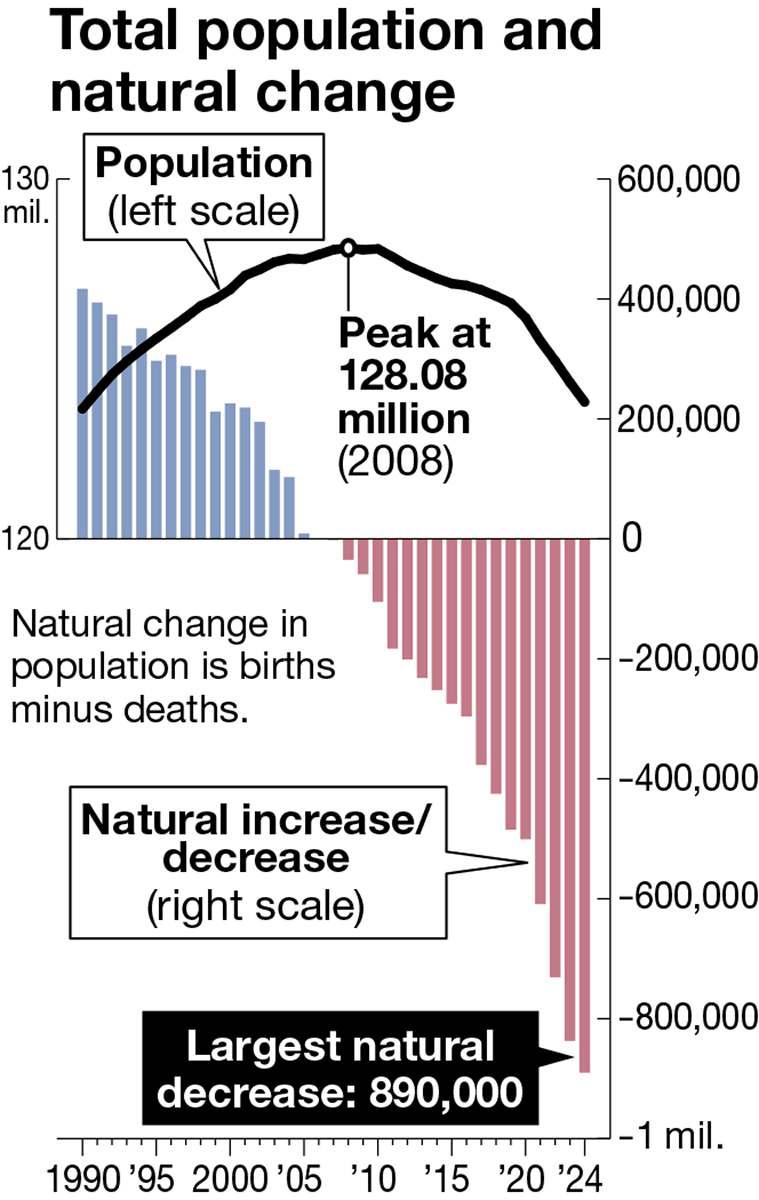
Japan’s natural population change has marked its largest ever drop, according to estimates released by the government on Monday. The figure is calculated by subtracting the number of deaths from the number of births.
The percentage of those age 65 or older also reached a record high.
The government intends to continue birth rate measures of a “different dimension,” as set forth by former Prime Minister Fumio Kishida, and to improve these measures, but it has not been able to effectively deal with population decline, which is advancing at a pace faster than it had anticipated.
“For many people who want to have children, their dream hasn’t come true,” Chief Cabinet Secretary Yoshimasa Hayashi said at a press conference Monday. “We will promote comprehensive measures to realize a society where everyone who wishes to have children can have children.”
The natural annual decrease hit 890,000 last year, up 53,000 from 2023. That total is nearly the population of Akita Prefecture (897,000). A median projection by the National Institute of Population and Social Security Research, published in 2023, had foreseen a natural decrease of 728,000 in 2024. The institute had estimated that the natural decrease would reach 890,000 in 2035, meaning the rate of decline is about 10 years ahead of schedule.
The government is moving forward with its “acceleration plan,” a three-year plan to intensively address the declining birth rate starting from fiscal 2024, but there have been no prospects of concrete results. The government is expanding child allowances and making it easier to obtain childcare, but the number of births continues to fall. Some within the government have said that government measures will not be enough to change the decisions of those who may give up on marriage and childbirth due to economic conditions and other factors.
There are also concerns about the impact on social security. According to a study of the pension system published by the Health, Labor and Welfare Ministry in 2024, if the economy continues to look as it has in the past 30 years, recipients of the national pension will receive 30% lower payments than at present. The study was based on the median estimate of births, so payments may be even smaller if births fall faster than expected.
“The effects of child-rearing support have not yet been felt,” said Hisakazu Kato, a professor specializing in population economics at Meiji University. “It is important not only to support households raising children, but also to give young people opportunities to get married and have children, such as by revitalizing local economies.”









Most Read
Most read in the last 24 hours
-

India's Arms Indigenization Quest for Self-Reliance / New Delhi S...
-

Bonds between Iran, Kikaijima Shine as Concerns Rise over Iranian...
-

Most Serious Cyberattacks against the UK Now from Russia, Iran an...
-

Iran Fires on 3 Ships in the Strait of Hormuz as US Maintains Blo...
-

Trump Envoy Seeks to Replace Iran with Italy in Upcoming World Cu...
-

EU Close to Approving a $106B Loan for Ukraine after Months of De...
-

White Sox Rookie Munetaka Murakami Ties MLB Rookie Record with HR...
-

Airline Company Lufthansa Cuts 20,000 Flights as War Squeezes Fue...
Most read in the last 7 days
-
Earthquake Hits Japan's Tohoku Region; 3-meter Tsunami Warning Is...
-

Trump Extends the Ceasefire with Iran but Keeps the Blockade
-

Olympic Gold Medal-Winning Figure Skaters Riku-Ryu Announce Retir...
-

China, South Korea Object to Japanese PM Takaichi's Ritual Offeri...
-

Japan to Ban Use of Portable Chargers on Airplanes from April 24,...
-
India's Arms Indigenization Quest for Self-Reliance / New Delhi S...
-

¥1,000 Coins to Be Issued to Mark Anniversary of Beginning of Jap...
-

New Challenges Await as Miura-Kihara Retires; Blade Maker, Ex-Coa...
Most read in the last 30 days
-
Earthquake Hits Japan's Tohoku Region; 3-meter Tsunami Warning Is...
-

Police Find Child's Shoe During Search for Missing Boy in Nantan,...
-

Body Found in Nantan, Kyoto Prefecture, During Search for 11-Year...
-

Cherry Blossoms, Rapeseed Flowers Perform Colorful ‘Duet’ in Niig...
-
Trump Extends the Ceasefire with Iran but Keeps the Blockade
-
Olympic Gold Medal-Winning Figure Skaters Riku-Ryu Announce Retir...
-

Nori Prices Surge in Japan Due to Poor Seaweed Production Amid Ri...
-

Japanese Prime Minister Takaichi Speaks to Pakistani Prime Minist...
Top Articles in Society
-
Earthquake Hits Japan’s Tohoku Region; 3-meter Tsunami Warning Issued (Update 1)
-
Police Find Child’s Shoe During Search for Missing Boy in Nantan, Kyoto Prefecture
-
Body Found in Nantan, Kyoto Prefecture, During Search for 11-Year-Old Boy in Area (Update 1)
-
Cherry Blossoms, Rapeseed Flowers Perform Colorful ‘Duet’ in Niigata
-

Two Women in Osaka Found Lying on Floor Bleeding, Later Pronounced Dead
JN ACCESS RANKING
-
Earthquake Hits Japan’s Tohoku Region; 3-meter Tsunami Warning Issued (Update 1)
-
Police Find Child’s Shoe During Search for Missing Boy in Nantan, Kyoto Prefecture
-
Body Found in Nantan, Kyoto Prefecture, During Search for 11-Year-Old Boy in Area (Update 1)
-
Cherry Blossoms, Rapeseed Flowers Perform Colorful ‘Duet’ in Niigata
-
Trump Extends the Ceasefire with Iran but Keeps the Blockade
Most read in the last 24 hours
-
India's Arms Indigenization Quest for Self-Reliance / New Delhi S...
-
Bonds between Iran, Kikaijima Shine as Concerns Rise over Iranian...
-
Most Serious Cyberattacks against the UK Now from Russia, Iran an...
-
Iran Fires on 3 Ships in the Strait of Hormuz as US Maintains Blo...
-
Trump Envoy Seeks to Replace Iran with Italy in Upcoming World Cu...
Most read in the last 7 days
-
Earthquake Hits Japan's Tohoku Region; 3-meter Tsunami Warning Is...
-
Trump Extends the Ceasefire with Iran but Keeps the Blockade
-
Olympic Gold Medal-Winning Figure Skaters Riku-Ryu Announce Retir...
-
China, South Korea Object to Japanese PM Takaichi's Ritual Offeri...
-
Japan to Ban Use of Portable Chargers on Airplanes from April 24,...
Most read in the last 30 days
-
Earthquake Hits Japan's Tohoku Region; 3-meter Tsunami Warning Is...
-
Police Find Child's Shoe During Search for Missing Boy in Nantan,...
-
Body Found in Nantan, Kyoto Prefecture, During Search for 11-Year...
-
Cherry Blossoms, Rapeseed Flowers Perform Colorful ‘Duet’ in Niig...
-
Trump Extends the Ceasefire with Iran but Keeps the Blockade