
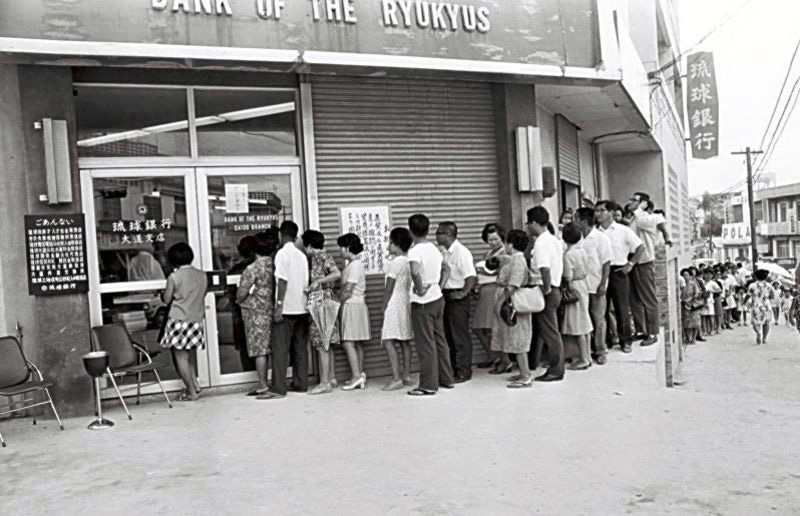
Residents wait in line outside a bank in Naha on Oct. 9, 1971, when a one-day “currency confirmation” procedure was held across Okinawa.
14:10 JST, January 25, 2022
This year, Okinawa marks the 50th anniversary of its return to Japan. This second installment of the “Origins” part of our anniversary explores some of the issues that have impacted Okinawa’s people since the handover, leading up to the present day.
On Oct. 9, 1971, about seven months before Okinawa’s reversion to Japan, residents formed long lines in front of banks, each holding American currency that they had earned or saved during the U.S. Occupation.
“We opened our branch at 8 a.m. All employees were on duty on that day,” said Shizue Nakamura, 74, who worked at a Bank of Okinawa branch in Koza, now part of the city of Okinawa. “With so many customers, it was a hectic day.”
Residents flocked to banks to report the amount of U.S. dollars they held as part of a currency confirmation procedure secretly planned without the knowledge of U.S. authorities by Japan and the Ryukyu Islands government, which administered the islands during the occupation.
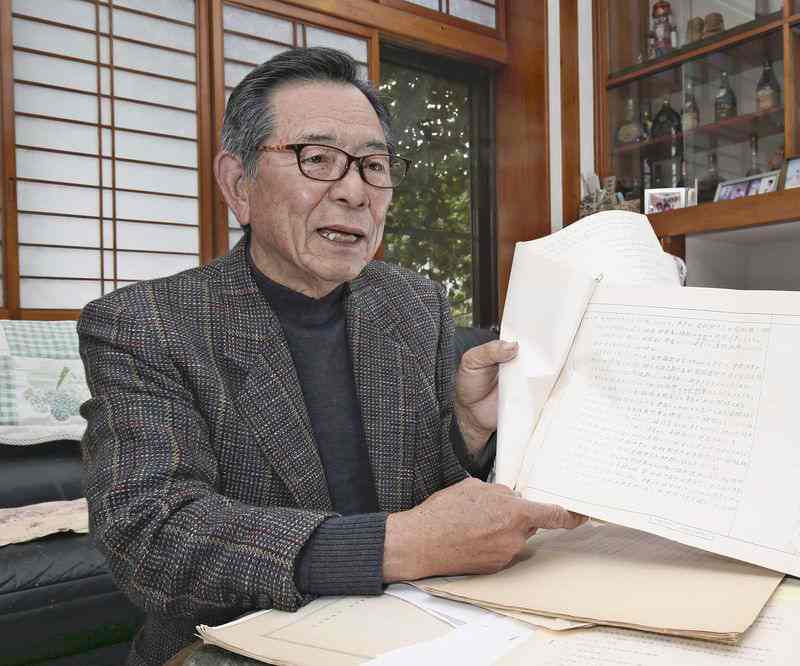
Masao Chinen shows documents related to the currency confirmation procedure in Nakagusuku, Okinawa Prefecture, on Jan. 12.
Following a depreciation in the dollar’s value, the record was needed to ensure that residents could be compensated when Okinawa’s official currency was changed from U.S. dollars to Japanese yen after the islands’ return to Japan.
The measure was triggered by the “Nixon Shock” in August 1971, when U.S. finances deteriorated due to fiscal stimulus linked to the Vietnam War that eroded the value of the dollar. The fixed exchange rate system of ¥360 to the dollar collapsed, triggering a shift to a floating exchange rate.
If no measure had been taken, residents would have been forced to exchange currency at a depreciated rate after Okinawa’s return to Japan on May 15, 1972.
“Officials of the Ryukyu Islands government were concerned about the loss of residents’ assets, so they contacted the Japanese government, which decided to offer compensation,” said Masao Chinen, 80, of Nakagusuku, who worked for the Ryukyu government at the time.
To calculate the compensation, it was necessary to tally the amount of currency held by residents on a predetermined day. The date was not made public until the last minute, as there was a risk that speculators in Japan and overseas would attempt to take advantage of the situation.
The Ryukyu Islands government set up a special unit comprising eight people, including Chinen, and in the days leading up to Oct. 9, the team gathered in an apartment outside of working hours to prepare. “I wasn’t allowed to tell anyone anything, even my boss and family members,” Chinen said. “They became suspicious about what I was doing.”
Eve of confirmation
The project was finally announced on Oct. 8. On the day of the confirmation process, vehicles with loudspeakers drove all around Okinawa from the morning, notifying residents that the dollars they held had to be counted by 10 p.m. at banks or special counters at community centers.
Dollar assets totaling about $60 million were confirmed on the day.
When the islands were returned to Japan, the exchange rate had dropped to ¥305 to the dollar. The Japanese government paid about ¥30 billion in compensation, covering both cash and bank deposits.
The measure, which caused upheaval to the lives of Okinawans, did not completely protect their assets, partly because U.S. currency acquired after the confirmation was not covered by the compensation, and prices rose sharply before and after Okinawa’s return to Japan.
Residents, fearing their assets would be diminished by the dollar-to-yen exchange at the time of the reversion, hoarded various products.
Price-gouging also happened. According to Okinawa prefectural data, the price of imported canned pork increased by 5.2%, beef loin by 20.9%, and soba noodles by 28.2%.
Shigeko Yamakawa, 77, of Naha, who was raising two young children around the time, said, “I used to cut a pork chunk into thick slices, but I started to cut it into small pieces to save food. I even felt that our life had been better under U.S. rule.”
Stunted manufacturing
The lack of development in Okinawa’s manufacturing industry has been widely attributed to the currency policy dating back to the U.S. occupation.
After World War II, the first currency used in Okinawa was not the dollar, but the “B yen” issued by the U.S. forces, which was three times the value of the standard yen.
It is said that the purpose of the currency was to speed up the construction of local military bases, as materials could be imported from other parts of Japan at low prices. Residents were also able to buy imported goods at lower prices by using the higher-value B yen.
When the dollar replaced the B yen in 1958, local residents were able to continue relying on inexpensive imports as the greenback also had a higher value than the Japanese yen.
“As foreign products were available at low prices, the manufacturing industry did not develop as it did on the mainland,” said Yoshiro Shimoji, a former professor at the University of the Ryukyus. The lack of a manufacturing industry meant fewer employment opportunities, leading to an industry centered on tertiary sectors such as tourism, according to Shimoji.






Most Read
Most read in the last 24 hours
-
Tokyo Vice Governor: SusHi Tech Tokyo Garners Tangible Business O...
-
Govt to Support Universities in 17 Strategic Fields to Boost Huma...
-
Japan to Host Leaders from Major Cities from Around the World for...
-

Iran's Top Diplomat Briefly Returns to Pakistan but Trump Says th...
-

Sabastian Sawe of Kenya Becomes First Person to Run a Sub-2-hour ...
-
M6.1 Earthquake Hits Hokkaido, Japan; No Tsunami Expected
-

DC Gala Shooting Suspect Aired Grievances against Trump in Writin...
-

Students’ ‘ITAMAE’ Project Boosts Interest in Starting Small Busi...
Most read in the last 7 days
-
China, South Korea Object to Japanese PM Takaichi's Ritual Offeri...
-
Trump Extends the Ceasefire with Iran but Keeps the Blockade
-

India's Arms Indigenization Quest for Self-Reliance / New Delhi S...
-
¥1,000 Coins to Be Issued to Mark Anniversary of Beginning of Jap...
-
Most Serious Cyberattacks against the UK Now from Russia, Iran an...
-

Trump Opposes United–American Merger, Signals Support for Spirit
-
System Malfunction in Haneda Airport Causes 83 Flight Cancelation...
-

Florida Launches Criminal Probe into OpenAI and ChatGPT over Dead...
Most read in the last 30 days
-
Earthquake Hits Japan's Tohoku Region; 3-meter Tsunami Warning Is...
-
Police Find Child's Shoe During Search for Missing Boy in Nantan,...
-
Body Found in Nantan, Kyoto Prefecture, During Search for 11-Year...
-
China, South Korea Object to Japanese PM Takaichi's Ritual Offeri...
-
Cherry Blossoms, Rapeseed Flowers Perform Colorful ‘Duet’ in Niig...
-
Trump Extends the Ceasefire with Iran but Keeps the Blockade
-

Olympic Gold Medal-Winning Figure Skaters Riku-Ryu Announce Retir...
-
Japanese Prime Minister Takaichi Speaks to Pakistani Prime Minist...
Top Articles in Society
-
Earthquake Hits Japan’s Tohoku Region; 3-meter Tsunami Warning Issued (Update 1)
-
Police Find Child’s Shoe During Search for Missing Boy in Nantan, Kyoto Prefecture
-
Body Found in Nantan, Kyoto Prefecture, During Search for 11-Year-Old Boy in Area (Update 1)
-
Cherry Blossoms, Rapeseed Flowers Perform Colorful ‘Duet’ in Niigata
-
Japan to Ban Use of Portable Chargers on Airplanes from April 24, Number of Regular Chargers To Be Limited to 2
JN ACCESS RANKING
-
Earthquake Hits Japan’s Tohoku Region; 3-meter Tsunami Warning Issued (Update 1)
-
Police Find Child’s Shoe During Search for Missing Boy in Nantan, Kyoto Prefecture
-
Body Found in Nantan, Kyoto Prefecture, During Search for 11-Year-Old Boy in Area (Update 1)
-
China, South Korea Object to Japanese PM Takaichi’s Ritual Offering to Yasukuni Shrine
-
Cherry Blossoms, Rapeseed Flowers Perform Colorful ‘Duet’ in Niigata
Most read in the last 24 hours
-
Tokyo Vice Governor: SusHi Tech Tokyo Garners Tangible Business O...
-
Govt to Support Universities in 17 Strategic Fields to Boost Huma...
-
Japan to Host Leaders from Major Cities from Around the World for...
-
Iran's Top Diplomat Briefly Returns to Pakistan but Trump Says th...
-
Sabastian Sawe of Kenya Becomes First Person to Run a Sub-2-hour ...
Most read in the last 7 days
-
China, South Korea Object to Japanese PM Takaichi's Ritual Offeri...
-
Trump Extends the Ceasefire with Iran but Keeps the Blockade
-
India's Arms Indigenization Quest for Self-Reliance / New Delhi S...
-
¥1,000 Coins to Be Issued to Mark Anniversary of Beginning of Jap...
-
Most Serious Cyberattacks against the UK Now from Russia, Iran an...
Most read in the last 30 days
-
Earthquake Hits Japan's Tohoku Region; 3-meter Tsunami Warning Is...
-
Police Find Child's Shoe During Search for Missing Boy in Nantan,...
-
Body Found in Nantan, Kyoto Prefecture, During Search for 11-Year...
-
China, South Korea Object to Japanese PM Takaichi's Ritual Offeri...
-
Cherry Blossoms, Rapeseed Flowers Perform Colorful ‘Duet’ in Niig...