
Games immerse players in circuit racing, Van Gogh’s world
By Futoshi Mori / Japan News Senior Writer
The latest game arcades and art exhibitions are said to be amazing. Thanks to the remarkable development of digital technology, the experiences they offer are entirely new. This reporter, an old man who only knows about two-dimensional games, visited two of the newest amusement spots in Japan.
Immersion in circuit racing「REDº TOKYO TOWER」
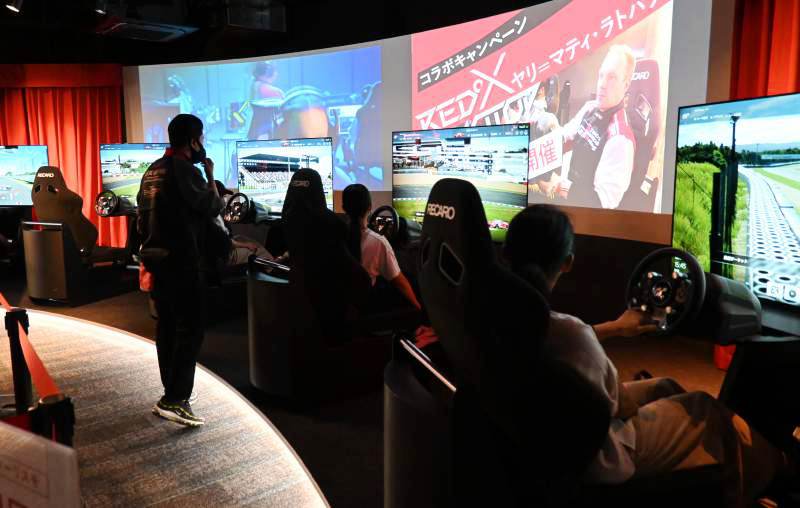
The first is REDº Tokyo Tower, a theme park that opened this April right under Tokyo Tower in Minato Ward, Tokyo. At this facility, where visitors can experience the latest digital entertainment and the world of e-sports, I got into a simulator used by professional racing drivers to drive around a circuit, and sweated it out in physical e-sports.
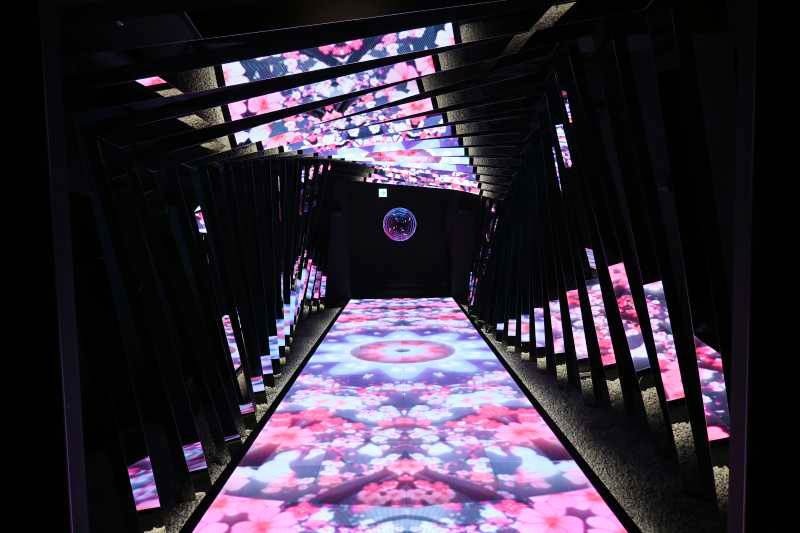
From the entrance on the third floor of Foot Town, I passed through a tunnel with beautiful visual effects inspired by the torii gate of a Shinto shrine, and entered the space for “entertainment in a different dimension.” The fifth floor, “Ultimate,” features the first theme park in Japan where visitors can enjoy a racing game and simulator together. I tried one of the seven simulators, some of which are the same models used by professionals for practice.
After a brief explanation of the controls from the staff, I put on the VR headset and found myself already in a racing car on the circuit. Turning my head left and right, I could see the scenery from the cockpit. It was like being in the pit. On the steering wheel, I could see my hands with gloves on them. I stepped on the accelerator and entered the circuit. The sound and vibration were incredible. The seat and steering wheel vibrated, and the steering wheel was heavy. Without slowing down sufficiently, the car entered a curve and suddenly veered off course, crashing into a side wall. I remembered that I had been told to brake when I saw a curve.
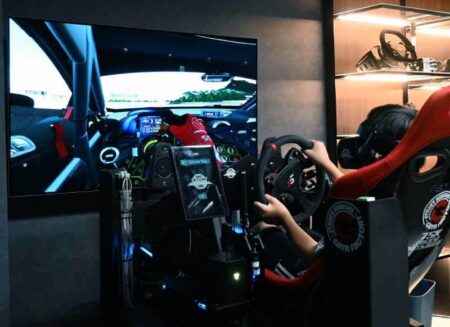
Simulator with VR goggles for driving on a circuit
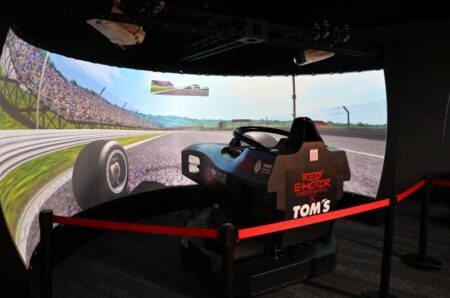
One of the racing simulators
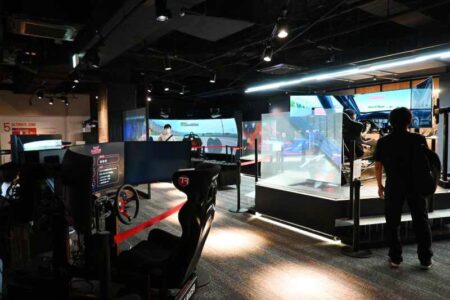
The area with seven racing simulators


I learned to slow down before the curve and accelerate from the latter half of the curve, and managed to get around the course. When I stepped on the brake, the vibration became even greater, and I had a hard time controlling the car with the heavy steering wheel. On the final straight before the grandstand, the machine reached 270 kph at full throttle in fifth gear with the sound of a roaring engine, which was exhilarating. After six minutes, it was over, before I could complete three laps of the circuit.
The staff praised me, saying, “You did well for your first time.” This simulator is not a race against other cars, but a time trial. It took me more than two minutes to complete one lap, but a good racer can complete a lap in one minute and 30 seconds. The VR images, the vibrating machines and the sound of the engines gave me a very realistic experience.
On the fourth floor, I participated in a “real” shoot-out with a “devil sergeant” captain, played by a staff member, shooting at the enemy in a war zone. A young female staff member, who was very polite at the entrance, immediately turned out to be the devil sergeant and told visitors as soon as we entered the room: “You guys! Follow me closely!” The role of the captain is played by staff members who have experience in theater or are trying to become voice actors, so it was like a fun combat version of Disneyland’s Jungle Cruise.
On the third floor, I experienced a terrifying attraction that is apparently only available in the Kanto area. Visitors walk through a virtual space on their own feet, wearing a VR headset and a belt with integrated motion sensors, and wander through a hall of horrors in search of the exit. I went up and down the stairs by moving my legs. When I opened the door with my hand, I heard an eerie sound. Weird phenomena occurred here and there, and ghosts appeared. I managed to reach the exit, but I can understand why some people scream in fear.
The name is not only REDº because of the red color of Tokyo Tower; the symbol next to the D is for degrees. Koki Nagano, 40, director of the facility, said: “Our goal is to raise the temperature and heat level of entertainment in Japan. That passion is also reflected in the red color. I hope everyone from children to adults will enjoy it.”
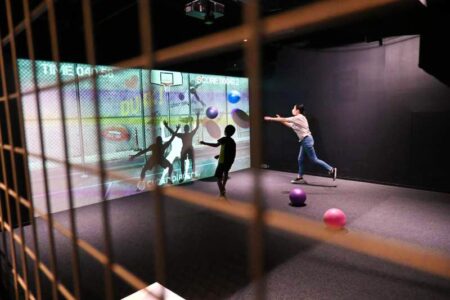
A mother and child enjoying an e-sport game in which balls are thrown against a wall.
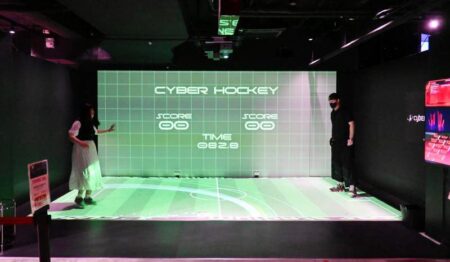
A couple enjoy a game of cyber hockey


Finally, I played a game in which the participants had to hit a rubber ball against numbers displayed on the wall by projection mapping. The numbers had to be hit in order from smallest to largest. The numbers appeared and disappeared, or moved sideways. The more I did it, the more serious I got. When I finished, I was quite sweaty and felt refreshed.
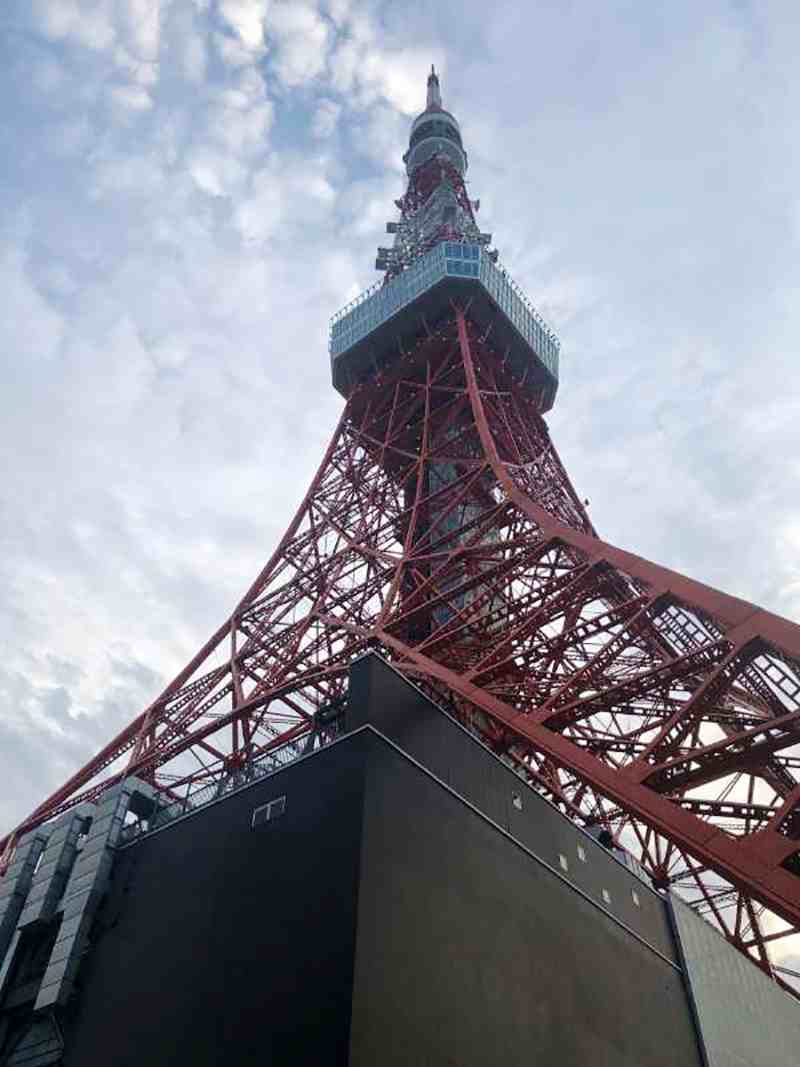
After the visit, I looked up at Tokyo Tower soaring above me in the hot summer sky. The Showa-era radio tower, completed in 1958, is still in good shape. I thought it was interesting to be able to experience the world of the near future at its feet.
REDº TOKYO TOWER
Open from 10:00 am to 10:00 pm, year-round. One-day passports and night passports are available, and you can come and go as you please during the day. For more information, visit the official website: https://tokyotower.red-brand.jp
Immersed in Van Gogh’s world「Kadokawa Culture Museum」
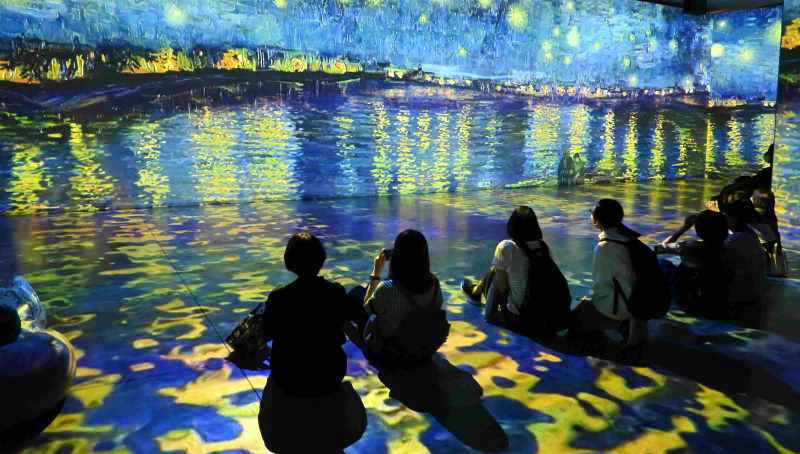
For a long time, I thought that paintings are only to be appreciated in art museums. And when it comes to world-famous paintings, crowds of people gather in front of them, making it difficult to appreciate them in a leisurely manner. However, my opinion changed when I visited “Van Gogh: This is How I See the World” at the Kadokawa Culture Museum in Tokorozawa, Saitama Prefecture. I became immersed in the images and sounds of Van Gogh’s world, and I found myself appreciating and acquiring knowledge of Van Gogh’s works. It was a completely new experience for me to enjoy art with my whole body, benefiting from the development of digital technology.
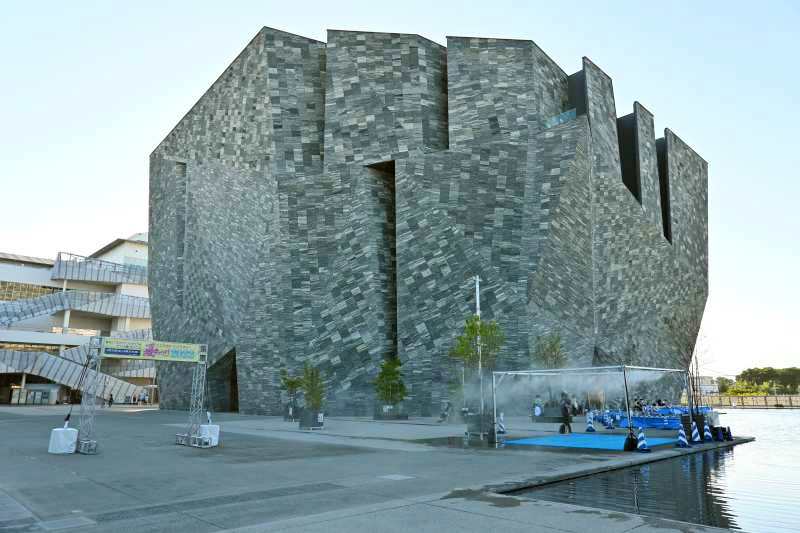
The Kadokawa Culture Museum, the design of which was supervised by world-renowned architect Kengo Kuma, has attracted much attention for its unconventional architecture. It has on its premises a digital theater with a 360-degree experience, the first of its kind in Japan. “Ukiyo-e Theater from Paris,” which ran until May of this year, was well received and the Van Gogh exhibition started as the second phase of the digital arts project.
Entering the Digital Theater, I instantly felt transported to Van Gogh’s world, with his paintings projected on the walls, pillars and floor of a huge space that could accommodate well over 100 people. “Sunflowers,” “The Yellow House,” “Bedroom in Arles,” “Self-Portrait,” and so on. Using 34 projectors, Van Gogh’s works and the world in which he lived were projected as one giant image along with beautiful music.
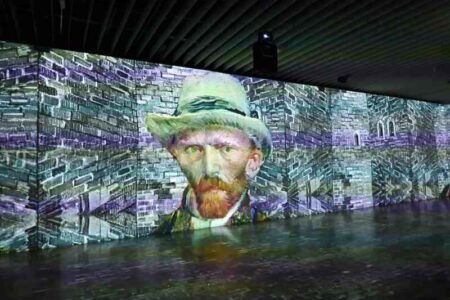
Van Gogh’s works are projected onto the walls.
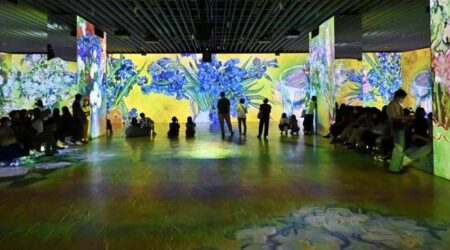
The giant space for the Van Gogh exhibition has 34 projectors.


The images and music, which take 30 minutes to complete a cycle, are divided into eight chapters, one for each theme, tracing Van Gogh’s tumultuous and eventful life. The exhibition is not limited to still images. Leaves falling from trees, landscapes moving and other digital tricks made me feel as if I were the one moving in the darkened hall. The shimmering surface of the water extended to my feet, making me feel as if I were really standing by the water’s edge.
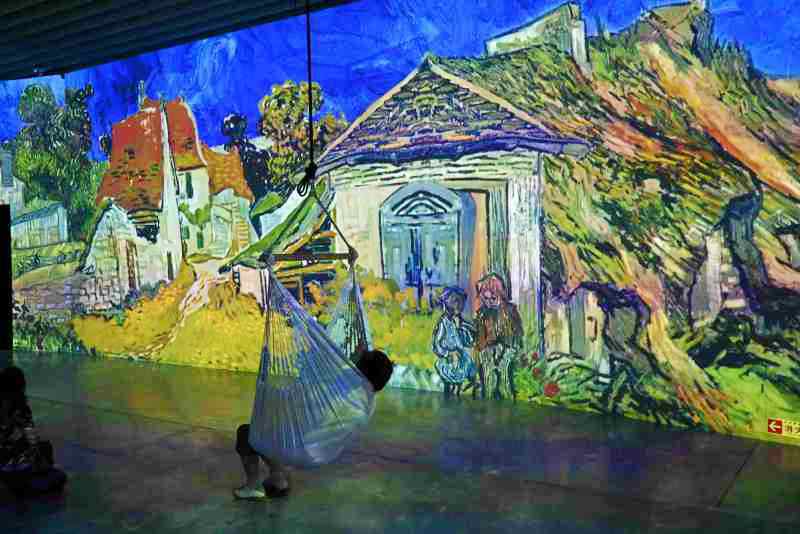
There is no proper way to appreciate the exhibition. You can walk around freely, sit on the floor or lie down. There were also hammocks and sofas in the hall, and some people were viewing the exhibits from them. Photography is also allowed (no video or flash). On the day I went, the majority of visitors were young couples and women. According to Shuzo Kumagai of Kadokawa Media House, who gave me a tour of the exhibition, it has become popular through social media.
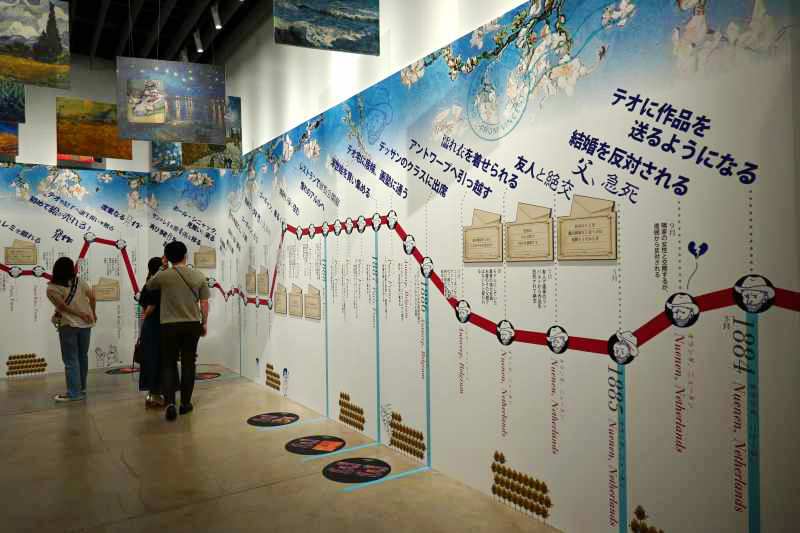
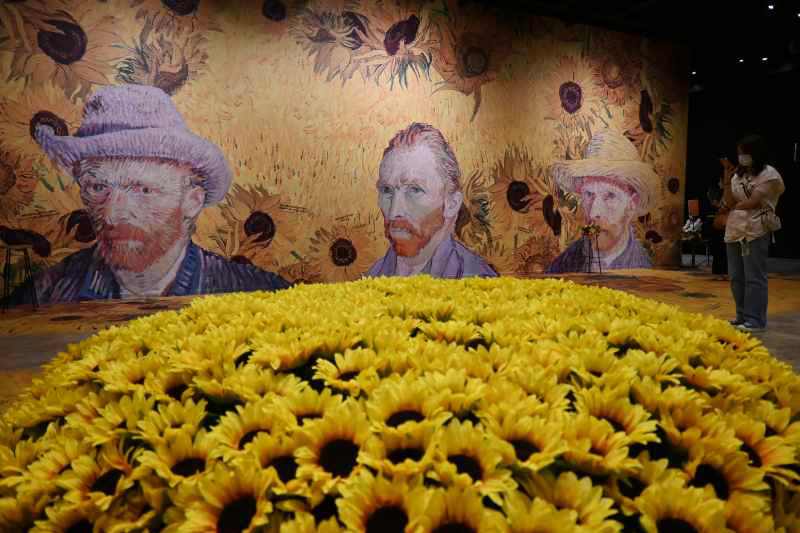
There are three exhibition venues. The first site is digital art that you can feel. The second is a place where visitors can enjoy learning about Van Gogh through a chronological table and letters on the theme of “Van Gogh’s life that you know yet don’t know.” A pop illustration shows a timeline of Van Gogh’s joys and sorrows on a red line graph, filled with ups and downs. For example, when a painting sells for the first time, the line rises dramatically. The third venue is a photo spot. Free artificial sunflowers and straw hats are placed in front of Van Gogh’s sunflowers and self-portraits, and visitors are free to take pictures using these items.
“Digital art is spreading worldwide and will grow in Japan as well,” said Hisashi Imai, 44, who produced the Van Gogh exhibition at the museum.
The exhibition was organized by Gianfranco Iannuzzi, a leading expert in digital art. He has successfully held digital art exhibitions of famous painters around the world. For this first showing in Japan, he restructured the composition and music. The emphasis was placed on the subtitle, “This is how I see the world.” He expressed the world as Van Gogh would have seen it.
“I think digital art is good for children who are experiencing art for the first time, because they can move around freely and feel the world of art.” Imai said. “I would like to continue to create high quality exhibits in the future.”
The Van Gogh paintings in the exhibition are not real. However, I felt the great potential of experiencing digital art, which you could say is more satisfying than appreciating real paintings.
Kadokawa Culture Museum
The Van Gogh exhibition will run through Nov. 27. The museum is open from 10:00 am to 6:00 pm (until 9:00 pm on Fridays and Saturdays). Closed on the first, third and fifth Tuesdays of the month. For more information, visit the Kadokawa Culture Museum website (https://kadcul.com).